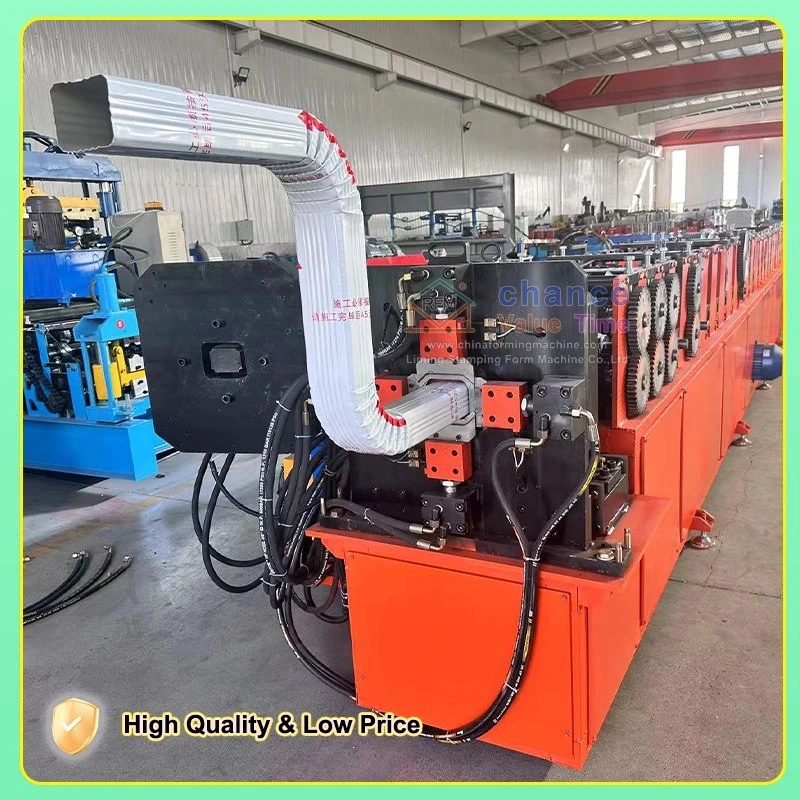
A downspout roll forming machine converts metal coil into consistent rainwater downspout profiles for gutter systems. A buyer who sources equipment overseas should compare more than speed and initial price. The right downspout roll forming machine manufacturer in China should understand the required profile, material, tolerance, automation level, and output. The downspout roll forming machine price in China also changes with these requirements, so buyers should define the finished product before comparing quotations.
What Is a Downspout Roll Forming Machine?
How the Process Works
A downspout forming line gradually shapes flat metal strip through multiple roller stations. Each station adds part of the deformation until the strip reaches its final cross-section.
A typical line includes a decoiler, guiding section, roll forming unit, cutting system, control system, and run-out area.
Common Downspout Profiles
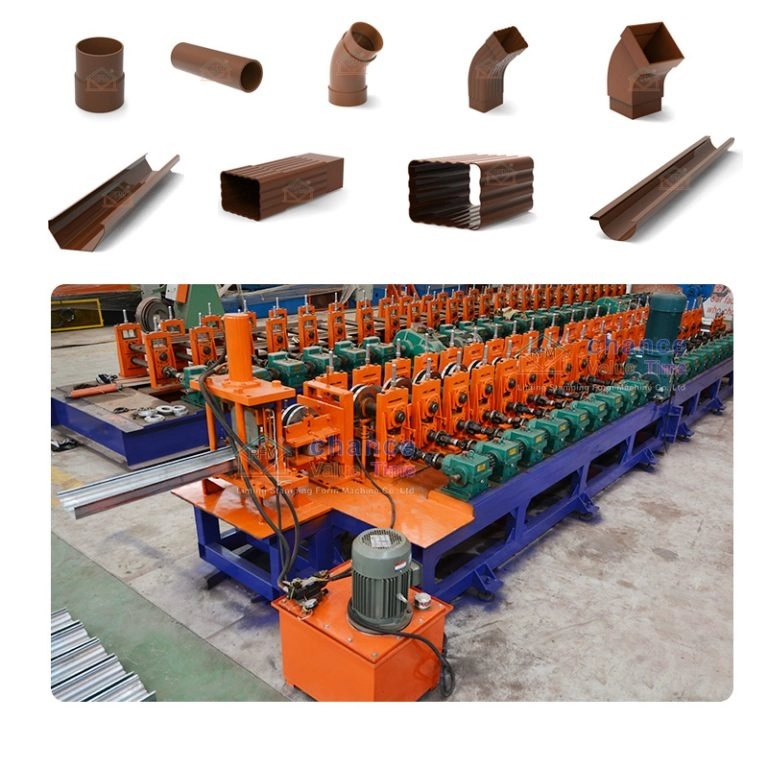
Manufacturers commonly produce rectangular, square, and round downspouts. Rectangular sizes such as 2 × 3 inches and 3 × 4 inches appear in several markets, while other projects use custom dimensions or round diameters.
Define the Finished Downspout First
Confirm the Profile, Sizes, and Tolerances
A buyer should provide a dimensioned drawing that shows width, height, corner radii, seam details, ribs, and connection features. A buyer should also define all required sizes, finished lengths, and tolerances.
Decide Whether You Need Multiple Profiles
A factory that produces one standard profile may only need a fixed-profile machine. A factory that serves several markets may need interchangeable tooling or an adjustable system.
Match the Machine to the Material
Galvanized Steel, Pre-Painted Steel, and Aluminum
Downspout production can use galvanized steel, pre-painted steel, or aluminum. The buyer should specify material type, thickness, coating, and mechanical properties when those values are available.
Material strength matters because different flow stresses can create different springback and edge behavior during successive forming passes.
Compare Key Machine Specifications
Forming System
The number of forming stations should match the profile complexity and material rather than a marketing target. The buyer should also review roller design, roller material, shaft support, machining accuracy, and frame rigidity.
Production Speed and Capacity
A buyer should request stable production speed under real forming and cutting conditions. A maximum unloaded speed does not represent practical output.
Select the Cutting and Automation System
Cutting Method
The cutting system should match the profile, finish, and production rate. A stop-to-cut system can suit moderate output, while a tracking cutting arrangement can support higher continuous production.
The buyer should define finished-length tolerance and inspect several consecutive pieces for burrs, deformation, and length consistency.
Control and Batch Production
A PLC-based control system can manage length, batch quantity, and machine sequences. An encoder can provide length feedback for automatic cutting.
Choose Between a Standalone Machine and a Complete Line
Main and Auxiliary Equipment
A complete downspout production line can include a decoiler, guiding system, roll former, cutting system, control system, discharge table, elbow-forming equipment, and end-forming equipment. Published configurations show that these functions can be combined according to the finished product.
The buyer should require every quotation to identify included, optional, and excluded equipment.
When Customization Is Necessary
A customized line may be necessary when the buyer needs local-market profiles, several sizes, multiple materials, unusual tolerances, or extra forming operations.
The supplier should explain the proposed tooling and process instead of simply calling the machine “customized.”
What Determines Downspout Roll Forming Machine Price in China?
Technical Factors Behind the Quotation
The downspout roll forming machine price in China depends on profile complexity, material range, speed, tooling, cutting method, automation, number of sizes, and auxiliary equipment.
Compare Total Project Cost
A low machine price does not always create a low project cost. The buyer should consider tooling, auxiliary equipment, freight, import expenses, unloading, and site preparation.
Every potential supplier should quote against the same technical specification.
How to Choose a Downspout Roll Forming Machine Manufacturer in China
Verify Factory and Engineering Capability
A buyer should verify the supplier’s legal identity, physical factory, production equipment, technical staff, assembly capability, quality-control process, and testing capability. Supplier-audit guidance recommends verifying actual production capacity and records instead of relying only on online presentation.
Evaluate Technical Communication
A capable supplier should ask detailed questions before issuing a final proposal. The supplier should request the profile drawing, material, thickness, speed, power, voltage, and required functions.
Hebei Liming’s quotation guidance also asks buyers to provide a dimension drawing and thickness and to state production speed, power, and voltage requirements in advance.
Test the Machine Before Shipment
Use a Defined Factory Acceptance Test
The buyer should approve a Factory Acceptance Test, or FAT, before shipment. The FAT should confirm that the equipment matches the purchase specification and approved drawings.
The test should use the specified material whenever possible. The buyer should measure profile dimensions, cut length, repeatability, continuous running, controls, and relevant safety functions.
A formal FAT should record measured results, document non-conformities, and verify corrective actions before shipment authorization.
Confirm Documents, Site Requirements, and Contract Scope
The buyer should receive final drawings, electrical documents, operating instructions, component information, and FAT records.
The purchase contract should define the approved profile, technical scope, FAT criteria, delivery milestones, packaging scope, and technical support.
Prepare a Better RFQ
Information Every Buyer Should Send
A clear RFQ should include:
- The buyer should provide a dimensioned profile drawing.
- The buyer should state material type, thickness, and available mechanical properties.
- The buyer should define sizes, lengths, tolerances, and required production speed.
- The buyer should provide destination voltage, frequency, and phase.
- The buyer should identify cutting, elbow-forming, end-forming, and auxiliary requirements.
- The buyer should state the destination country and project requirements.
Common Buying Mistakes and Final Checklist
Mistakes Buyers Should Avoid
A buyer should not compare prices before comparing technical scope. A buyer should not send only a product photograph or specify thickness without material information.
A buyer should not request maximum speed without calculating real capacity. A buyer should also avoid approving shipment after only watching a short running video when measurable FAT criteria are required.
Final Checklist
The buyer should confirm the profile drawing, materials, sizes, speed, cutting method, automation, line scope, factory capability, documents, FAT criteria, site utilities, shipping responsibilities, and total quotation scope before signing the order.
FAQ
Can One Machine Produce Different Downspout Sizes?
One machine can produce different sizes when its tooling and adjustment system are engineered for that requirement. The buyer should confirm the size range and changeover method before ordering.
How Many Forming Stations Does a Downspout Machine Need?
No universal station number fits every profile. The required roll-pass design depends on geometry, material properties, thickness, and dimensional requirements.
What Should a Buyer Check During FAT?
The buyer should check machine configuration, actual-material production, profile dimensions, cut-length repeatability, continuous operation, controls, safety functions, and required documents.
What Information Is Needed for an Accurate Quotation?
The supplier normally needs a profile drawing, material, thickness, required sizes, production speed, finished length, voltage, and auxiliary-equipment requirements.
Request a Custom Downspout Roll Forming Machine Quote
Hebei Liming states that the company has 30 years of experience in the design, development, and manufacturing of roll forming machines, and its website lists downspout machines among its product categories. The company also states that it provides customized solutions for specific production requirements.
For a customized metal roof tile making machine solution, detailed technical proposal, and quotation, contact Hebei Liming today. The buyer can submit the roof profile drawing and production requirements through the contact page, and the technical team can review the project specifications and recommend an appropriate machine configuration.