The pipe welding roll form machine, also known as a high frequency welded pipe mill or ERW pipe welding machine, offers a steady way to turn flat metal coils into exact-welded pipes. This gear makes round, square, rectangular, and custom-shape tubes. The tubes have firm, good seams along their length. They fit the strict needs of fields like construction, furniture, automotive, and basic building.
Core Principles of High-Frequency Welding in Pipe Welding Roll Form Machine
High-frequency welding in a pipe welding roll form machine uses magnetic pull to make strong, local heat at the strip edges. It runs at rates from 200 to 450 kHz. The setup uses the skin effect and proximity effect. These focus power right where edges touch. They heat edges to a soft or almost liquid state in less than a second. Then, press rolls push the hot edges together under set force. This forms a clear, solid weld without added metal. The method creates a small heat zone. It causes little bend. It gives strong seams. Plus, it allows speeds of 30–100 meters per minute.
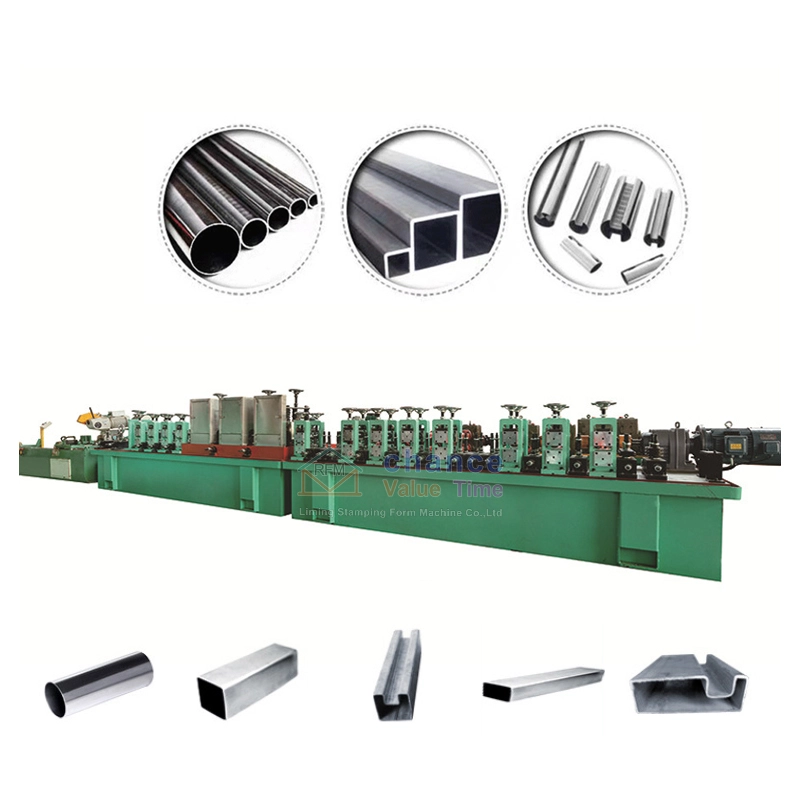
Step-by-Step Operation of Pipe Welding Roll Form Machine
A full pipe welding roll form machine line uses a matched, fast flow of steps:
- Coil loading and uncoiling feed raw metal strips (carbon steel, stainless steel, aluminum, etc.) into the system.
- Strip leveling and edge conditioning prepare the material for accurate forming.
- Progressive roll forming gradually shapes the flat strip into an open tube.
- High-frequency welding fuses the seam.
- Rapid cooling stabilizes the weld zone.
- Sizing and straightening refine final dimensions and geometry.
- Flying or tracking cutting produces accurate pipe lengths.
This smooth link lets steady, large making go on. Quality stays even.
Detailed Breakdown of Forming Process in Pipe Welding Roll Form Machine
The forming part stands as the main frame of every pipe welding roll form machine. It has many exact-made roller spots. These often number 10 to 20 or more. They slowly change the flat strip. First spots start light curve. Middle spots close the shape. They make a small vee gap at the seam. Last spots line up edges just right for welding. This slow change cuts inside strains. It keeps wall thickness the same. It hits size limits as close as ±0.2 mm.
Current pipe welding roll form machines often add fast-swap roller setups or block plans. These let quick shifts between pipe sizes and shapes. Downtime drops.
High-Frequency Welding Mechanism in Pipe Welding Roll Form Machine
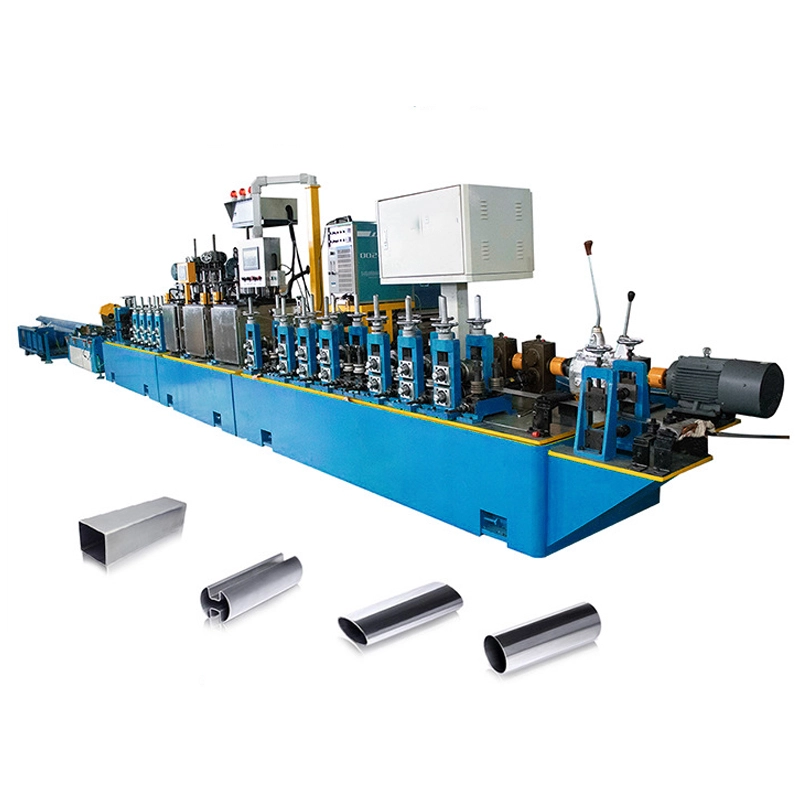
At the weld spot of the pipe welding roll form machine, an induction coil or slide contact setup sends high-frequency current to the seam area. The current starts strong eddy flows. These heat only the aimed edges fast. The rest of the tube stays fairly cool. The skin effect packs current at the face. The proximity effect boosts heat between close edges.
Right after heat, press rolls use exact push force. They push out face rust and dirt. They join edges into a strong weld. The seam shows pull strength that matches or beats the base metal. Defect risk stays low.
Post-Welding Processes in Pipe Welding Roll Form Machine
After the weld spot, the pipe welding roll form machine uses good after-weld steps to ensure end quality:
- Intensive cooling (via water sprays, air jets, or combination systems) quickly quenches the weld zone, locking in microstructure and preventing cracks or softening.
- External deburring removes weld beads for a smooth surface finish; internal scarfers can eliminate inside beads when required.
- Sizing stands pass the pipe through additional roller sets to achieve exact outer dimensions, improve roundness, and correct any residual ovality or curvature.
- Straightening units ensure the finished pipe remains perfectly straight over its length.
These steps together give tubes set for next steps or direct send.
Advantages Delivered by Pipe Welding Roll Form Machine
Pipe welding roll form machines bring top skill and fit. They reach high make rates with low power use and small waste. This cuts run costs a lot. The high-frequency weld gives better pull strength, pressure hold, and evenness than many other ways.
These machines handle material thickness from 0.5 mm to 3.0 mm. Some special types go beyond. They fit a wide range of pipe widths and shapes. New PLC-run control setups allow exact speed control, auto size shifts, live watch, and check tools. This boosts trust and simple use.
Key Applications Powered by Pipe Welding Roll Form Machine
Pipes made on pipe welding roll form machines fill key jobs in many areas:
- Construction — structural supports, scaffolding, handrails, and fluid conduits.
- Furniture — frames, legs, chair bases, and decorative tubing with smooth, attractive finishes.
- Automotive — exhaust systems, chassis components, roll cages, and fluid-carrying lines.
- Agriculture and machinery — frames, supports, hydraulic tubing, and protective casings.
The mix of speed, exactness, and low cost makes high frequency welded pipe mills the top pick for making strong, good tube goods.
Steps forward in auto, power save, and smart checks keep growing the skills of pipe welding roll form machines. They push more output and fit in current making.
Frequently Asked Questions (FAQ)
What materials can a pipe welding roll form machine process? Carbon steel, stainless steel, aluminum, and other conductive metals are compatible, typically in thicknesses ranging from 0.5 mm to 3.0 mm.
What production speeds are typical for a pipe welding roll form machine? Speeds generally range from 30 to 100 meters per minute, depending on pipe diameter, wall thickness, and model configuration.
How does high-frequency welding in a pipe welding roll form machine compare to other methods?
It offers faster heating, narrower heat-affected zones, no filler material, higher line speeds, and stronger forged welds with lower overall energy use.
Which industries rely heavily on pipes from pipe welding roll form machines? Construction, furniture manufacturing, automotive, agricultural equipment, and general industrial fabrication are primary users.
What factors most influence weld quality in a pipe welding roll form machine?
Edge alignment precision, stable high-frequency power delivery, consistent squeeze pressure, and immediate controlled cooling are critical.
Ready to Upgrade Your Pipe Production Capabilities?
Business seeking to improve output quality, accelerate production rates, and lower manufacturing costs can benefit from state-of-the-art pipe welding roll form machine solutions. As a leading manufacturer, supplier, and factory, Hebei Liming provides robust, customized high-frequency welded pipe mills supported by extensive technical expertise, reliable global after-sales service, and precision engineering. Contact the team today for detailed specifications, tailored machine configurations, and competitive quotations to optimize your production lines. Reach out by phone at 0317-8223331, WhatsApp at +86 17761521505, or email at admin@chinaformingmachine.com.