Light keel roll forming machines hold an important place in today’s construction world. They work especially well in light steel framing systems. These special machines create exact light gauge steel keels. Builders use them for walls, ceilings, floors, and structural supports in homes and business buildings. Demand keeps rising for building ways that save time, last long, and help the environment. So light gauge steel keel roll forming machines provide fast production of steady profiles such as C, U, omega, and stud/track sections.
Light gauge steel keel roll forming machines turn thin metal coils into light but tough parts. This helps the growth of prefabricated and modular building methods. The technology cuts down waste, gives great accuracy, and allows scaling up. Manufacturers get steady results in light steel keel production.
What is Light Keel?
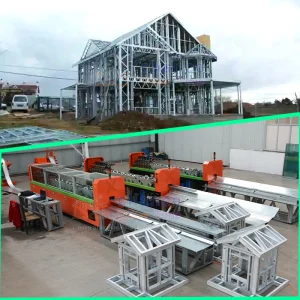
Light keels mean cold-formed steel sections. Their web heights usually stay below 180 mm. Material thicknesses go from 0.5 mm to 3 mm. Common shapes include C studs, U tracks, omega furring channels, and L angles. People often make them from galvanized steel, cold-rolled steel, or stainless steel coils. These parts act as framing pieces in drywall systems, suspended ceilings, partition walls, and light steel structures.
In light steel construction, light keels form the basic frame. They work for non-load-bearing or partly structural uses. This setup allows fast putting together and joining with gypsum boards or other panels.
Advantages of Light Keels
Light keels give a better strength-to-weight ratio than old materials like wood or heavy steel. Because they weigh less, transport, handling, and setup become easier. At the same time, they lower the total load on the building. Galvanized coatings bring good protection against rust. This lengthens useful life. Also, steady dimensions stop warping when conditions change.
Other plus points cover fire resistance, no termite damage, and easy recycling. Because of these, light gauge steel keel roll forming machines suit green building projects well. Efficient production lets makers add custom punching, dimpling, or service holes right in the line.
Working Principle of Light Keel Roll Forming Machine
The main process in a light keel roll forming machine uses steady bending. It shapes flat metal strips through many roller stations. First, coiled material uncoils. Then it straightens and moves into the forming area. There, rollers gradually form it into the wanted shape. No heat gets added.
This cold-forming way keeps things precise and repeatable. Servo-driven setups along with length encoders manage cutting to exact sizes. As a result, output rates stay high.
Roller Stations
Roller stations make up the main part of the machine. The number runs from 10 to 20. It depends on how complex the profile is. Each station bends the strip a little more. This spreads the change evenly and avoids heavy stress spots. Rollers use high-hardness alloy. They get chrome plating or heat treatment. So they hold accuracy during long production runs.
Components of Light Keel Roll Forming Machine
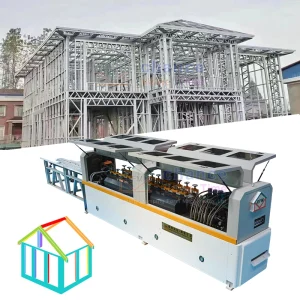
Feeding Section
The feeding section has a decoiler. It can be manual or hydraulic. Coil loading capacity goes up to several tons. A straightener removes coil set. This helps material enter smoothly.
Forming Section
This part includes strong side frames. They hold the roller stands. Rollers fix on precise shafts. Gearboxes or chains drive them. This gives steady torque.
Cutting Section
Hydraulic or flying shears make clean cuts without burrs. Post-cut or pre-cut choices fit various production needs. Servo tracking helps flying cuts stay accurate.
Control System
PLC-based controls come with touch-screen HMI. They handle settings like speed, length, and punching. Automation features cover batch counting and recipe storage. These allow fast changeovers.
Structural Frame and Housing
Heavy-duty steel frames use C-channel or I-beam. They support the machine weight and handle vibrations. Safety guards, emergency stops, and enclosures meet industrial rules.
Technical Specifications
Typical light gauge steel keel roll forming machines work with thicknesses of 0.5-3 mm. Web heights go from 50-180 mm. Flange widths reach up to 80 mm. Production speeds hit 8-15 m/min. Some advanced models go higher. Main motor power sits at 3-7.5 kW. Hydraulic power stays around 4 kW. Machine weight falls between 3000-8000 kg. This keeps the unit stable at high speeds.
How to Choose a Light Keel Roll Forming Machine
Choice relies on production amount, range of profiles, automation degree, and budget. Look at coil details, needed accuracy (±0.5-1 mm), and extras like automatic size change or in-line punching. Energy-saving electric types and quick-change setups cut downtime on multi-profile jobs.
Manufacturers of Light Keel Roll Forming Machines
Global suppliers provide machines from simple semi-automatic to full automatic lines. Chinese manufacturers lead with affordable and customizable choices. European brands put emphasis on top precision and modern controls.
How to Operate a Light Keel Roll Forming Machine
Start operation with safety checks. Verify guards and look at lubrication. Load material onto the decoiler. Thread it through the machine. Set parameters on the control panel. Once started, watch to keep flow smooth. Then collect finished items and follow normal shutdown steps.
Advantages and Disadvantages
Advantages include high output, even quality, less need for workers, and flexibility with complex shapes. Disadvantages cover high starting costs, time to set up new profiles, and requirement for skilled upkeep.
Light Keel Roll Forming Machine Maintenance
Keep bearings and chains lubricated regularly. Check rollers for wear. Look at alignment. Service the hydraulic system. These steps make the machine last longer. Clear away debris. Watch electrical parts. This avoids sudden stops.
Troubleshooting Common Problems
Problems like material jamming usually come from poor alignment or wrong tension. Profile distortion can happen because of worn rollers. Uneven lengths often point to encoder issues. Careful checks and small fixes solve most troubles fast.
Safety Tips
Operators need to wear PPE. Keep loose clothing away from moving areas. Use lockout/tagout during maintenance work. Emergency stops and safety interlocks keep people safe.
Frequently Asked Questions (FAQ)
What profiles can light gauge steel keel roll forming machines produce?
These machines commonly produce C studs, U tracks, omega channels, L angles, and custom drywall profiles for light steel framing.
What accuracy and repeatability should be expected?
High-quality machines achieve length accuracy of ±1 mm and profile tolerances within 0.5 mm, with consistent repeatability across batches.
How to choose between hydraulic and all-electric forming and cutoff?
All-electric models offer energy savings, quieter operation, and faster changeovers, while hydraulic provides robust power for thicker materials.
Can one machine handle multiple keel sizes without long downtime?
Advanced automatic model change systems allow quick adjustments for sizes like C75, C89, C140, minimizing setup time.
What coil specs matter most for light keel quality?
Coil width tolerance, yield strength (e.g., 345-550 MPa), zinc coating uniformity, and flatness directly impact final profile quality and machine performance.
Partner with a Trusted Manufacturer for Light Gauge Steel Keel Roll Forming Machines
For manufacturers, suppliers, and factories seeking reliable, high-performance light gauge steel keel roll forming machines or fully automatic light steel framing solutions, Hebei Liming stands out as an experienced manufacturer and supplier with nearly 30 years in the industry. Specializing in customizable light gauge steel frame machines, including C89, C140, and truss roll forming lines compliant with international standards, the company delivers durable equipment, innovative designs, and comprehensive after-sales support. Contact Hebei Liming for tailored quotations, OEM services, and global export expertise to enhance production efficiency in light steel construction. Reach out today via their official site at lmrfm.com for professional solutions.