What Is Roll Forming?
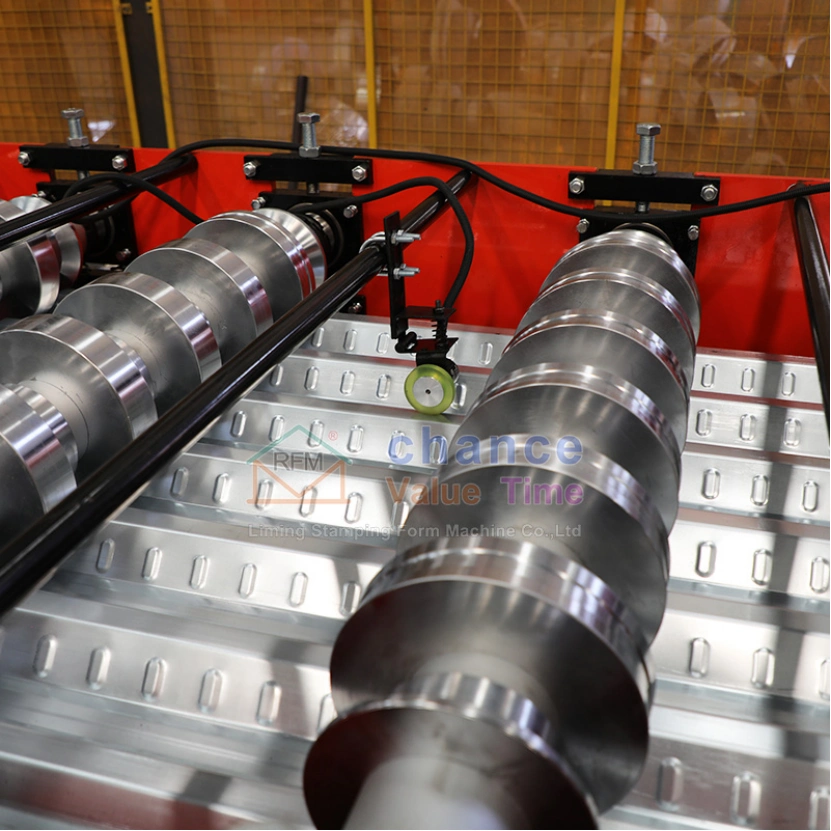
Roll forming represents a continuous bending operation that transforms long strips of metal, often sourced from coil stock, into precise cross-sectional profiles. The material advances through a series of calibrated rolls, where each pair imparts incremental bends to progressively achieve the target shape. This technique excels in generating extended, uniform profiles suitable for large-scale output.
Key advantages of products derived from roll forming include reduced weight relative to extruded alternatives, thanks to thinner gauge sections; enhanced structural integrity from cold-working induced hardening; superior throughput via automated, uninterrupted cycles that conserve energy; and simplified finishing, as pre-applied coatings like galvanization remain intact without necessitating post-process treatments.
In essence, roll forming delivers a streamlined, automated methodology for fabricating uniform metal sections, optimizing scalability and consistency in manufacturing environments.
What Is a Roll Forming Machine?
Introduction to Roll Forming Machines
Roll forming machines constitute essential apparatus in metal fabrication, facilitating the creation of components integral to infrastructure and consumer goods alike. These systems produce items ranging from garage door panels and vehicle bodywork to roofing elements, wall claddings, purlins, frames, and barriers, supporting diverse sectors through efficient profile generation.
Definition and Basic Working Principle
A roll forming machine converts flat metal coils or strips into elongated sections featuring consistent cross-sections. Material feeds into successive roll stations, where each assembly applies targeted deformation, gradually molding the strip via plastic yielding into its permanent form. Upon completion, sections undergo length-specific shearing and collation. Roll configurations dictate profile intricacies, yielding exact tolerances even for multifaceted geometries.
Overview of the Roll Forming Process and Its Applications
The roll forming sequence entails ambient-temperature cold bending of strips, yielding extended members with stable profiles. Gradual roller progression averts abrupt strains, preserving material uniformity and mitigating residual stresses. Precision enables fabrication of profiles like channels, angles, and enclosures, serving automotive, building, aviation, and appliance domains.
Renowned for throughput, fidelity, and economy, these machines dominate production of intricate, superior metalwork, curbing scrap and aligning with contemporary fabrication benchmarks.
Evolution of Roll Forming Technology
Roll forming’s lineage extends to antiquity, with manual precedents, but industrialized iterations surfaced amid the 18th-century mechanization era, chiefly for roofing fabrication. Contemporary iterations incorporate CAD/CAM for augmented exactitude and velocity, alongside robotic integration to curtail intervention and amplify scope.
Workflow of a Roll Forming Machine
Roll forming workflows encompass staged manipulation of coils through uncoiling, alignment, shaping, augmentation, and severance, culminating in packaged outputs. This integrated continuum spans ingress to egress.
Pre-Processing Stage
Uncoiling via passive mandrels liberates coils for downstream transit. Straightening units eradicate undulations, ensuring planarity. Servo-driven feeders meter ingress with micron-level precision, sustaining cadence and metrics.
Forming Process
Strips traverse multi-station formers, where opposed rolls incrementally contour via sustained compression. Tooling alloys endure rigors, with station multiplicity scaling to profile sophistication, material resilience, and gauge.
Dies delineate contours sequentially, adapting to substrate attributes for optimal deformation without fracture.
Secondary Operations (Post-Forming Processing)
Post-primary shaping, adjuncts refine attributes: automated perforation, grooving, ablation, fusion, recalibration, fastening, and sub-assembly. Inline execution post-severance or offline specialization bolsters adaptability, conforming to rigors in erection, transit, renewables, and apparatus.
Punching timing—pre- or post-form—balances complexity against economy; hydraulic severance post-forming demands site optimization to safeguard integrity.
Die Cooling and Adjustment
Friction-induced thermals necessitate mitigation via convective or immersive regimes, stabilizing geometries. Modalities trade efficacy for intricacy, selected per throughput imperatives.
Pre-Cut vs. Post-Cut Comparison
| Process | Precut Advantages | Precut Disadvantages | Postcut Advantages | Postcut Disadvantages |
|---|---|---|---|---|
| Economizes on shear tooling; burrless termini; simplified upkeep | End flaring in profundities; station proliferation elevates expense; deformation susceptibility in brevity | Amplifies yield; averts jams; micro-length viability (2-3 inches) | Augmented tooling outlay; intensified servicing; potential terminal artifacts |
Defect Correction and Adjustment
Undulations, curvatures, or torsions arise from accrued tensions; compensatory straighteners rectify inline, restoring planarity.
Safety and Operational Protocols
Elevated velocities mandate safeguards: credentialed oversight, enclosures, cyclical audits, and meticulous reconfiguration. These protocols underpin uninterrupted efficacy.
Roll Forming Die System: Rafted Tooling
Rafted architectures pre-assemble dies on axles per phase, expediting swaps via modular exchanges—often under an hour—curtailing downtime and variance.
Complete Roll Forming Line Workflow
Lines orchestrate uncoilers, guides, optional prepunchers, formers, aligners, shears, and collectors. Progressive stationing evolves sections; terminal severance accommodates variability sans reconfiguration. Adjuncts like fusion integrate seamlessly, yielding conveyance-ready outputs with minimal post-care.
Key Components of a Roll Forming Machine
Machine Base
Fabricated from ferrous alloys, the plinth anchors operations, damping oscillations to preserve fidelity. Robustness averts deviations, with design prioritizing seismic resilience.
Roller Stands and Tooling
Arrays of stands host paired cylinders, sequentially deforming passersby. Quantum and layout mirror profile demands. Ancillary fixtures—dies, spacers, rails—codify geometries, bespoke to requisites.
Drive System
Propulsion variants encompass geared mechanics for affordability; hydraulics for torque; servos for acuity. Electronics enable granular oversight, suiting sophistication.
Setup and Operation of Roll Forming Machines
Roll Forming Machine Production Setup
Initiation entails die prep, stand tuning, and parametric harmonization. Alignment precludes skews; configurations tailor velocity, ingress, and excision to specs, optimizing yield.
Machine Operation
Runtime governs via velocity modulation—balancing quality, rate, energetics—and ingress uniformity to forestall anomalies. Vigilance detects aberrations, prompting recalibrations.
Safety Considerations in Roll Forming Operations
Mitigation hierarchies PPE mandates, doctrinal drills, device validations, and perimeter awareness. These frameworks curtail exposures in dynamic environs.
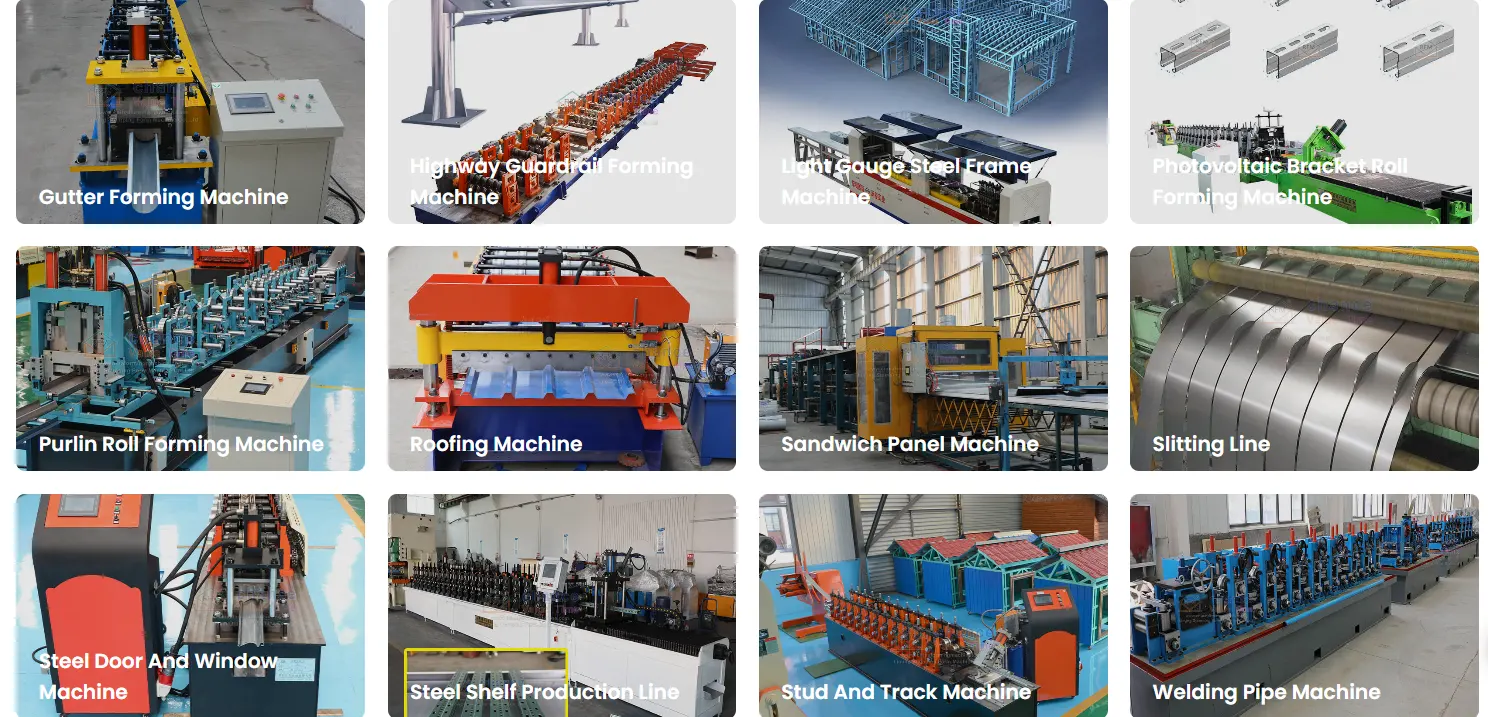
Common Types of Roll Forming Machines (By Application and Product Type)
| Category | Roll Forming Machine Types | Application Scenarios |
|---|---|---|
| Structural Building | Floor Deck Roll Forming Machine; Light Keel Roll Forming Machine | Steel frameworks, decking, suspensions |
| Cladding & Roofing | Wall Panel Roll Forming Machine; Sandwich Panel Roll Forming Line | Enclosures, insulations, cold chains |
| Doors & Frames | Roller Shutter Door Forming Machine; Door Frame Roll Forming Machine | Barriers, casings |
| Transportation | Highway Guardrail Roll Forming Machine; Truck Body Panel Forming Machine | Safeguards, chassis |
| Piping Systems | Tube Mill Line (Square/Rectangular Pipe); Rainwater Downpipe Forming Machine | Drainage, conduits |
| Storage Racking | Racking Upright Roll Forming Machine; Beam/Bracket Roll Forming Machine | Shelving, logistics |
| Solar Mounting | Solar Mounting Bracket Roll Forming Machine | Photovoltaic arrays |
| Cable Management | Cable Tray Roll Forming Machine; Cable Trunking Roll Forming Machine | Electrics, conduits |
| Custom Profiles | Custom Profile Roll Forming Machine | Bespoke geometries |
Why Choose Roll Forming?
High-Volume Production
Surpassing 10,000 units, roll forming amortizes fixtures via repetition, slashing marginals through automation.
Complex Metal Designs
Inline assimilation of apertures, indents, imprints obviates externalities, streamlining ornate functionals sans velocity penalties.
Advantages of Roll Forming
Economies stem from substrate thrift and process consolidation; velocities eclipse intermittents, curbing idles. Versatility spans DX51 to S390 substrates; ambient execution conserves watts while fortifying outputs. Synergies with perforation, ablation augment modularity for frames, dampers, framings.
Applications of Roll Forming Machines
Main Application Areas
Erection leverages for sheeting, struts; automotives for rails, reinforcements; logistics for uprights; renewables for mounts; transit for panels; agriculture for bins, enclosures.
FAQ
What materials are commonly used in roll forming?
Galvanized steel, PPGI, aluminum, and high-strength alloys like S390 suit most applications due to their formability and corrosion resistance.
How does roll forming compare to extrusion?
Roll forming operates at ambient temperatures for lighter, stronger profiles with lower energy use, ideal for continuous lengths, whereas extrusion requires heating for thicker sections.
What is the typical production speed of a roll forming machine?
Speeds range from 12-60 meters per minute, depending on profile complexity and material thickness.
Can roll forming machines handle custom profiles?
Yes, bespoke configurations accommodate unique geometries via tailored tooling and CAD integration.
What maintenance is required for roll forming equipment?
Routine inspections of rollers, lubrication of drives, and calibration checks ensure longevity, with full audits quarterly.
Partner with Hebei Liming, the Premier Roll Forming Machine Manufacturer, Supplier, and Factory
Hebei Liming , a trusted roll forming machine manufacturer, supplier, and factory with 28 years of expertise, invites manufacturers and suppliers to explore customized solutions for elevated production efficiency. Specializing in high-precision equipment like roofing machines, purlin roll formers, sandwich panel lines, and welding pipe machines, the company delivers durable, automated systems backed by global installations and OEM services. Contact Hebei Liming today at +86 17761521505 or admin@chinaformingmachine.com to request a quote and integrate innovative metal forming technology into operations.