A sandwich panel roll forming machine is an integrated manufacturing system that profiles metal facings and combines them with an insulating core to produce roof and wall panels. Manufacturers researching how does a sandwich panel roll forming machine work must evaluate the complete sequence from coil feeding and metal forming to core integration, bonding, cutting, and finished-product output. A clear understanding of sandwich panel production line components also supports accurate equipment selection and factory planning.
Insulated sandwich panels contain two metal skins and a rigid insulation core. The combined structure creates a lightweight panel that can provide enclosure, thermal insulation, and useful spanning capability. Common core materials include expanded polystyrene, polyurethane, polyisocyanurate, mineral wool, and rock fibre.
What Is a Sandwich Panel Roll Forming Machine?
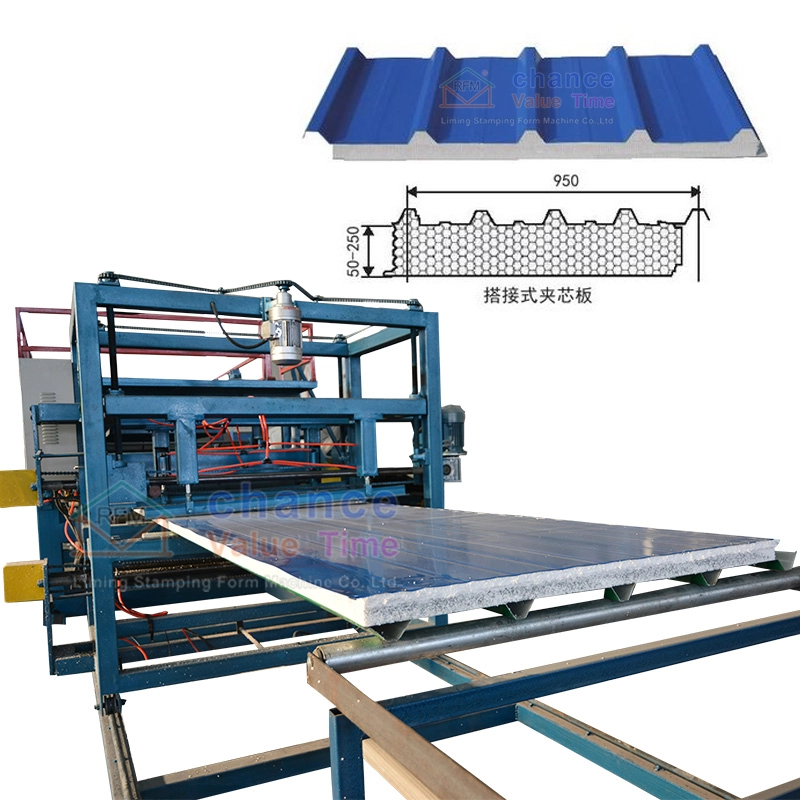
A sandwich panel roll forming machine produces composite panels through a coordinated manufacturing process. The roll forming section gradually bends flat metal strip through multiple roller stations, while downstream equipment positions or forms the insulation core and joins the layers.
The term “machine” sometimes refers to the central forming and laminating equipment. The term “production line” normally includes decoilers, forming units, core-handling equipment, adhesive or foaming systems, pressing equipment, cutting systems, controls, conveyors, and optional stacking equipment.
How Does It Differ from a Basic Roll Former?
A basic roll former produces a single-layer metal profile. A sandwich panel line produces a bonded construction product with upper and lower metal facings and an insulation core.
This difference makes process coordination essential. Sheet alignment, core positioning, bonding conditions, cutting accuracy, and output handling all influence finished-panel geometry and surface quality.
How Does a Sandwich Panel Roll Forming Machine Work?
A sandwich panel production line follows a controlled sequence:
- The decoilers release the upper and lower metal coils.
- The guiding systems align the sheets before forming.
- The roller stations create ribs, grooves, surface patterns, and edge joints.
- The core-handling system positions insulation between the metal facings.
- The bonding system applies adhesive or introduces reactive foam.
- The laminating section maintains pressure while the bond develops.
- The cutting system separates panels at the programmed length.
- The conveyor transfers finished panels for stacking or packing.
An EPS production line can include feeding, profile forming, adhesive coating, compositing, heating, cooling, automatic cutting, and finished-product output. The exact sequence varies according to the selected core material and production-line configuration.
How Do the Forming and Bonding Stages Interact?
The forming stations shape the external profile and panel joints without removing material. Each station performs a controlled portion of the total bend, which supports stable profile geometry and consistent dimensions.
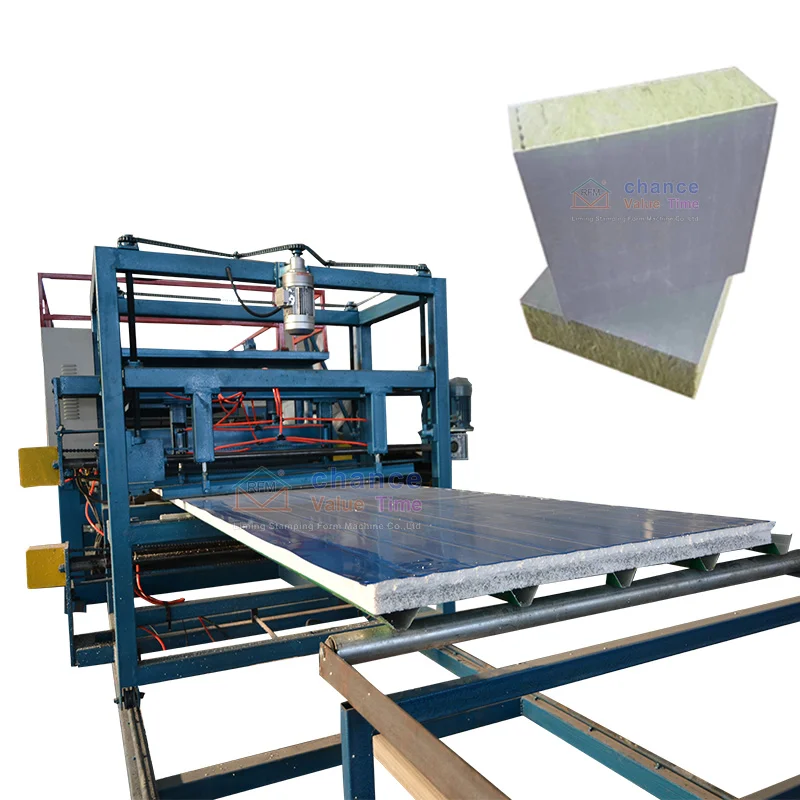
The bonding stage joins the metal facings and insulation core. Preformed EPS boards or mineral wool slabs generally require controlled feeding and adhesive application. Continuous PU or PIR lines form the foam core between the facings and require metering, mixing, pressure, and curing control.
What Are the Main Sandwich Panel Production Line Components?
The main sandwich panel production line components perform separate but interdependent functions. Stable production depends on coordination between material feeding, metal forming, core positioning, bonding, cutting, and control systems.
Decoilers, Guides, and Roll Forming Units
The decoilers support and unwind the metal coils. The guiding systems center the sheets and maintain a stable material path before the material enters the forming stations.
The upper and lower roll forming units create the required surfaces and joint details. The roller design must correspond to the approved panel drawing, material thickness, material strength, surface coating, and effective panel width.
Core, Bonding, and Laminating Systems
The core-handling system processes boards, slabs, strips, or foam-forming materials. Uniform core placement supports consistent panel thickness, edge alignment, and bonding area.
The adhesive or foaming system must suit the selected facing and core materials. The laminating section applies controlled pressure while the bond develops. Continuous production lines may use a double-belt arrangement to distribute pressure across the panel surface.
Cutting, Conveying, and Control Systems
The length-measuring system sends panel-length data to the controller. The cutting unit separates the product through a synchronized or stationary cutting method, depending on the production-line design.
A central control system coordinates material feeding, line speed, process settings, length measurement, cutting, and alarms. Conveyors move completed panels toward manual collection or automatic stacking.
Which Materials and Machine Configurations Are Available?
Metal facings commonly include pre-painted steel, galvanized steel, aluminum-zinc-coated steel, and aluminum. The machine specification must define sheet thickness, usable width, coil weight, coating, and mechanical properties because these factors influence the decoiler, drive system, roller design, and forming sequence.
EPS, Rock Wool, and PU/PIR Lines
An EPS line normally inserts preformed insulation boards, applies adhesive, presses the layers, and cuts the bonded panel. A rock wool line requires suitable handling for dense fibrous slabs or strips and may include additional core alignment or arrangement equipment.
A PU or PIR line produces the insulation core through a continuous foam-in-place process. This configuration requires chemical metering, mixing, expansion, controlled pressure, and sufficient curing time. A production line cannot be assumed to process every core type without compatible feeding, bonding, and laminating systems.
Roof and Wall Panel Configurations
Roof panels commonly use pronounced ribs or corrugations to support drainage and exposure to external weather conditions. Wall panels often use flatter, grooved, or micro-ribbed surfaces to meet functional and architectural requirements.
Panel joint geometry also affects the tooling design. Overlapping joints, tongue-and-groove edges, and concealed-fastener details require different roller profiles and dimensional controls.
Where Are Sandwich Panels Used?
Sandwich panels serve as roof and wall cladding in industrial buildings, warehouses, commercial facilities, cold-storage buildings, clean rooms, and prefabricated structures. Their integrated metal skins and insulation core allow one factory-produced element to provide enclosure and thermal insulation.
Cold-storage and controlled-environment projects place particular importance on panel thickness, joint accuracy, airtightness, and thermal continuity. Industrial projects may prioritize spanning capability, weather resistance, installation method, surface profile, and compatibility with supporting steelwork.
Which Specifications Determine Machine Suitability?
A suitable machine configuration begins with a dimensioned panel drawing. The drawing should identify the effective width, total width, core thickness, surface profile, joint geometry, and required cutting length.
The production specification should contain the following information:
- The specification should define the facing material, thickness, coating, and coil dimensions.
- The specification should identify the insulation core and required thickness range.
- The specification should state the target output under defined production conditions.
- The specification should include the local voltage, frequency, and control requirements.
- The specification should identify the required automation, stacking, and packaging scope.
- The specification should describe the available factory space and utility connections.
Published production speed should be evaluated together with the core process, curing time, panel dimensions, cutting method, and material handling. The nominal forming speed alone does not represent daily saleable output.
How Should Equipment Proposals Be Compared?
A technical comparison should examine the complete supply scope rather than the headline machine price. Each proposal should identify standard equipment, optional equipment, profile tooling, control functions, utility requirements, installation responsibilities, and acceptance criteria.
The approved product drawing should remain the central technical reference. A factory acceptance process can include sample-panel production, dimensional inspection, surface review, cutting verification, and documentation checks.
The total investment also depends on core-processing equipment, automation, conveyors, stacking systems, shipping, commissioning, and factory preparation. A lower initial quotation may exclude systems that remain necessary for commercial production.
FAQ
Can One Line Produce Roof and Wall Panels?
One production line can produce both products when its forming units, tooling arrangement, laminating range, and changeover method support both profiles. The supplier must confirm the capability against the required roof and wall panel drawings.
Can One Line Process EPS and Rock Wool?
A combined production line may process both materials when it includes compatible core handling, adhesive application, pressing, and changeover systems. Compatibility cannot be assumed because EPS boards and mineral wool products require different handling conditions.
What Information Is Required for a Quotation?
A technically useful quotation requires the panel drawing, metal-facing specification, core material, width and thickness ranges, target output, electrical standard, automation scope, factory conditions, and equipment destination. The manufacturer can use this information to determine the appropriate tooling and production-line configuration.
How Much Factory Space Does the Line Require?
The required factory area includes the production line, decoilers, core storage, material-loading space, output conveyors, stacking areas, operator access, and safe material movement. A scaled production layout provides a more reliable planning basis than the machine length alone.
Discuss a Suitable Production-Line Configuration
Hebei Liming designs and manufactures roll forming equipment, including EPS sandwich panel machines and sandwich panel roof production lines. The company states that it has 28 years of experience and provides customized configurations based on panel drawings and production requirements. A preliminary technical discussion can begin with the required profile, facing material, core type, production capacity, factory voltage, and available installation space.
Project details can be submitted through the Hebei Liming contact page, and the technical team can review the information and provide an initial equipment configuration for further discussion.