The unistrut channel roll forming machine serves as special industrial equipment built to produce continuous metal strut channels. People often call these unistrut channels. The profiles usually have a C-shape or U-shape cross-section. They come with pre-punched slotted holes. This design gives flexible support for mounting, bracing, and structural connections. The machine changes flat metal coils—like galvanized steel, low-carbon steel, or stainless steel—into accurate, strong channels. It does this through step-by-step cold roll forming, punching, and cutting steps.
Key technical points cover material thicknesses from 1.5–3.0 mm. Common profile sizes include 41×41 mm and 41×21 mm. Options exist for 41×61 mm, 41×52 mm, 41×62 mm, 41×82 mm, or custom versions. Production speeds run from 3–30 m/min. The speed depends on the setup and whether shear is included. Newer models have electric width adjustment. This allows multiple sizes. They use hardened rollers (Gcr15 steel, HRC 58-62), chrome-plated surfaces, and PLC automation. These features help keep output steady.
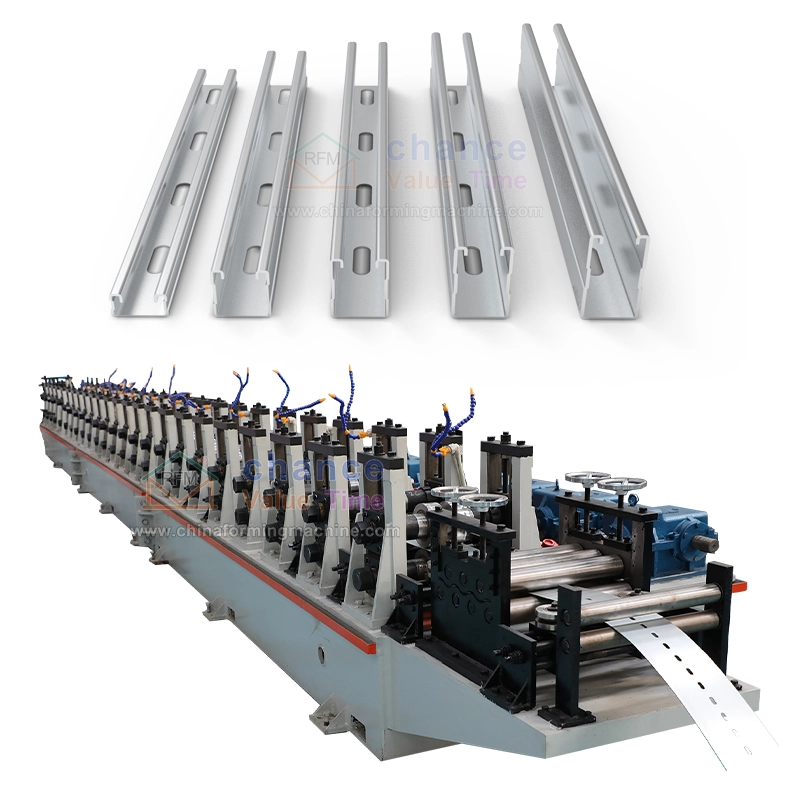
This equipment works well with light gauge steel frame roll forming machine tasks in structural builds. It creates tough profiles and keeps material waste very low.
Brief Introduction to Unistrut Channel Roll Forming Machine
The unistrut channel roll forming machine handles the job of turning raw metal coils into ready strut channels. These fit solar photovoltaic brackets and other structural needs. The machine works with different setups. It includes slotted patterns for easy assembly.
The usual workflow includes these steps:
- Decoiling raw coils (manual, hydraulic, or automatic, e.g., 5T–10T capacity).
- Leveling the strip so it stays flat. This uses several roller groups.
- Servo-controlled feeding. It keeps alignment exact.
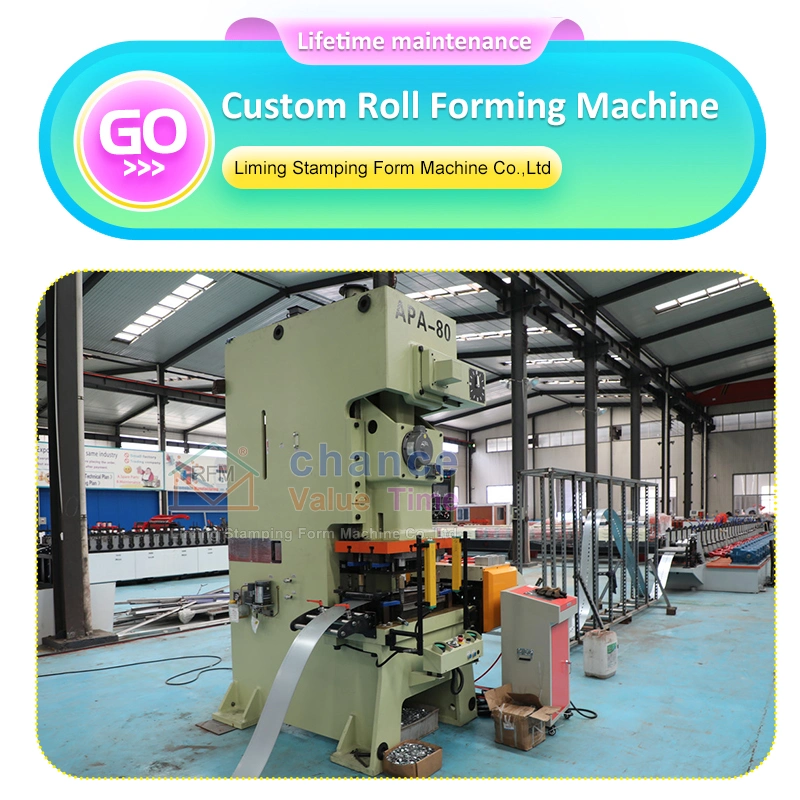
- Punching holes or slots when needed. High-speed presses do this (e.g., 80–125T).
- Progressive forming. It happens over many stations (often 18–22 passes) with gearbox or chain drive.
- Hydraulic cutting to the right length. Servo-tracking often helps with precision.
- Discharge and optional automatic stacking.
Control systems use Panasonic or similar PLCs. Main drive power sits around 22–55 kW. Hydraulic stations run at 5.5–15.5 kW (up to 12 MPa pressure). Shafts (e.g., φ60–76 mm, 45# steel) and strong parts provide solid performance. Equipment size is about 10–20 m × 1.0–1.5 m × 1.0–1.2 m. Voltage can match local standards.
Such machines reach tolerances like ±1.5 mm over 3 m lengths. They support fast, large-scale production.
Key Components of Unistrut Channel Roll Forming Machine
Modern unistrut channel roll forming machines include joined high-precision parts. These allow smooth work.
- Decoiler and Leveler — Hydraulic or automatic units manage coil loading. They flatten the material at the start to avoid defects.
- Servo Feeder and Punching Unit — Accurate feeding pairs with pneumatic or hydraulic punching dies. This makes precise slots and holes quickly.
- Main Roll Forming Section — The central part has 18–22 stations. Quenched Gcr15 rollers bend the strip slowly into the C/U shape. Cooling sprays often handle heat from bending.
- Hydraulic Cutting System — Servo-tracking or flying cut gives clean ends without burrs. The line does not need to stop.
- Control and Auxiliary Systems — PLC interface sets parameters. Accumulators keep production going during coil changes. Run-out tables hold finished items.
These parts lead to dependable, high-speed output.
Application Areas of Unistrut Channel Roll Forming Machine
The channels provide flexible support in many settings. They work especially well in solar energy setups.
- Rooftop solar systems — Channels build stable PV mounting brackets. These fit flat, pitched, or curved roofs. They stand up to wind, snow, and heat changes. This keeps panels in good position.
- Ground-mounted solar farms — Strong profiles hold big arrays at the best tilt angles. They handle tough weather. This boosts energy output and lasting use.
- Floating solar installations — Lightweight, rust-resistant channels stay steady on water. They deal with waves and wear.
- Solar carports — Combined structures offer shade for cars plus power creation. More places use them in cities and businesses.
- Off-grid solar energy solutions — Safe mounting for panels in far-off spots like telecom sites or remote facilities improves energy self-reliance.
Outside solar, channels help with construction jobs. Examples include pipe hanging, cable management, shelving, and mechanical/electrical bracing. This matches light gauge steel frame roll forming machine methods in modular building.
Advantages of Unistrut Channel Roll Forming Machines
These machines bring practical and cost benefits thanks to current design.
- High production efficiency — Speeds reach up to 25–30 m/min (without shear). This allows fast output, cuts cycle time, and lowers labor.
- Precision forming — Many hardened, chrome-plated roller stations create exact bends, sharp edges, steady slot positions, and consistent quality. Accuracy stays at millimeter level.
- Automation features — PLC setup, servo systems, sensors, and optional accumulators reduce hand work, mistakes, and stops. Results stay even during coil switches.
- Material and profile flexibility — It processes galvanized, stainless, or mild steel. It allows different sizes (e.g., 41×21 to 41×82 mm) through adjustable tooling or quick changes.
- Waste minimization — Continuous roll forming cuts scrap compared to cutting or welding options. This drops costs and helps the environment.
- Long-term reliability — Tough parts (e.g., Cr12Mov blades, quenched rolls, heavy-gauge frames) give long service and fit standard fittings.
These features suit the equipment for growing production in tough markets.
Design and Manufacturing Challenges of Unistrut Channel Roll Forming Machine
Building good machines means dealing with several engineering issues.
- Material compatibility — Finding the right balance of strength, formability, and rust resistance for various steels needs careful choice and tests.
- Roller and tooling precision — Creating multi-pass stations (18+ lanes) for detailed profiles without problems calls for skilled CAD/CAM and heat treatment knowledge.
- Automation synchronization — Linking servo feeding, punching, and cutting with PLC controls demands smooth teamwork. This keeps speed and precision.
- Efficiency vs. quality trade-offs — Adjusting power, hydraulic steadiness, cooling (e.g., sprays for heat control), and speed while keeping tolerances and good surface requires constant effort.
Solving these issues leads to strong, high-performing equipment for factory needs.
FAQ
What materials are suitable for unistrut channel roll forming machines?
Low-carbon steel, galvanized steel, and stainless steel in thicknesses of 1.5–3.0 mm are commonly processed.
What profile sizes can these machines produce?
Standard sizes include 41×41 mm, 41×21 mm, and variants like 41×61 mm, 41×52 mm, 41×62 mm, 41×82 mm; customization supports wider ranges and multi-profile capability.
What production speeds are achievable?
Typical ranges are 3–30 m/min, influenced by model, punching complexity, and shear operations.
How is accuracy maintained during forming?
Servo feeding, hardened Gcr15 rollers (HRC 58-62), chrome plating, and PLC controls ensure tight tolerances (±1.5 mm/3 m).
Which sectors benefit from these machines?
Solar photovoltaic mounting, construction framing, electrical/mechanical support, and general structural applications.
Can machines be customized?
Yes, options include adjustable widths, specific punching patterns, higher speeds, added automation features, and multi-size tooling.
Ready to Invest in a Reliable Unistrut Channel Roll Forming Machine?
Hebei Liming stands as an experienced manufacturer, supplier, and factory with 28 years in roll forming technology. The company offers customized photovoltaic bracket and strut channel production lines featuring advanced Panasonic PLC controls, high-power configurations (e.g., 45 kW main motor), precise tolerances, and lifetime maintenance support. Products emphasize durability, efficiency, and adaptability for global markets.
Explore detailed specifications, quotations, or factory VR tours at www.lmrfm.com. Contact the team for tailored solutions, technical consultations, or support in scaling strut channel manufacturing operations.