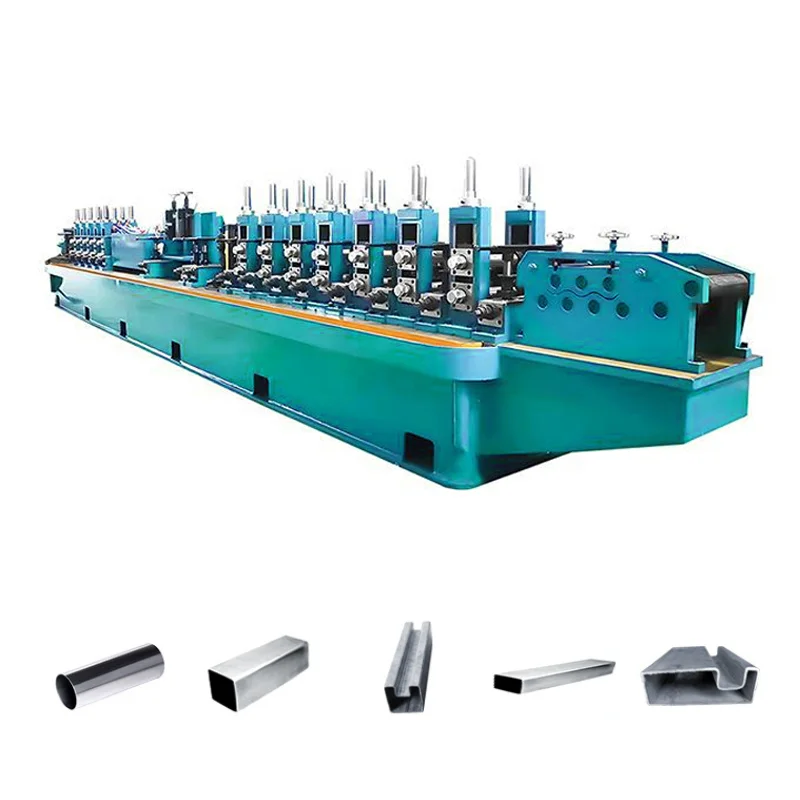
A steel welding pipe forming machine is industrial equipment that forms flat steel strip into welded steel pipe through continuous feeding, roll forming, high frequency welding, sizing, cutting, and inspection. A modern high frequency welded pipe production line helps factories produce round, square, and rectangular pipes for construction, furniture, machinery, automotive parts, fencing, and general fabrication. An ERW steel pipe making machine usually combines mechanical forming, electrical welding, cooling, shaping, automatic cutting, and control systems into one continuous production process.
What Is a Steel Welding Pipe Forming Machine?
The steel welding pipe forming machine is a production line made to transform steel coil or steel strip into welded steel pipe.
The machine does not only weld pipe. The machine also feeds the raw material, forms the strip into a tube shape, welds the seam, cools the pipe, adjusts the final size, cuts the pipe to length, and sends the finished product to the output area.
The machine is commonly used in factories that need continuous pipe production. The machine can support stable output, repeatable pipe dimensions, and efficient production when the machine configuration matches the required pipe size and material.
A complete welded pipe production line consists of several sections. Each of the individual sections is used for a specific task within the overall production of a pipe.
How Does a Steel Welding Pipe Forming Machine Work?
The steel welding pipe forming machine produces pipe in a continuous process from steel coil to finished welded pipe.
The Production Line Feeds and Prepares the Steel Coil
The production line starts by loading a steel coil into the feeding system.
The feeding system feeds the steel strip into the forming section at a predetermined speed. Steel strip should run smoothly and evenly to the forming section, because problems with the feeding system can affect forming as well as welding.
The preparation stage can include guiding, leveling, and strip positioning. The goal is to keep the strip flat, centered, and ready for roll forming.
The Forming Section Shapes the Steel Strip Into a Tube
In the forming section, the flat steel strip is bent step by step by a number of rollers.
With every roller station the work piece is changed in form and size. The first ones start the bending process and the others in between push the two strip edges together.
The forming section must also control the strip edge position to ensure the two edges meet correctly prior to welding. If the edges are not aligned correctly then the resulting weld seams can be weak or of an uneven profile.
The High Frequency Welding Unit Joins the Pipe Seam
The high frequency welding unit heats the strip edges with high frequency electrical energy.
The heated edges move toward squeeze rollers. The squeeze rollers press the two edges together and form a longitudinal seam along the pipe.
This stage is the core of a high frequency welded pipe production line. The welding result depends on material condition, strip edge quality, welding power, line speed, and squeeze pressure.
A stable welding process results in consistent seam quality in the finished pipe.
The Cooling and Sizing Sections Stabilize the Pipe
After the weld seam has been produced the welded pipe has to be allowed to cool.
The cooling section is used to reduce pipe temperature to enable pipe to be stable for subsequent process stages. The pipe is then sent to the sizing section.
The sizing section uses rollers to adjust the final outside diameter, shape, straightness, and dimensional accuracy. This section can help form round pipe, square tube, or rectangular tube when the tooling and machine design support the required profile.
The Cutting System Cuts the Pipe to Length
The cutting system cuts the continuous delivery pipes to the required length.
Pipe can be cut to any length required by the customer. It is critical that we cut the pipe to exact length as the finished length of pipe will affect how pipe can be packed and transported and also affect how pipe can be installed and processed by downstream trades.
Automatic cutting enables factories to work continuously without a complete standstill on their production line.
The Finished Pipe Output Enters Quality Checking
Cut pipes are moved to the output area after they have been cut.
The operator can check the pipe surface, pipe shape, cutting length, weld appearance, and dimensional accuracy. These checks help the factory confirm whether the finished pipe meets the required application standard.
Main Components of a Steel Welding Pipe Forming Machine
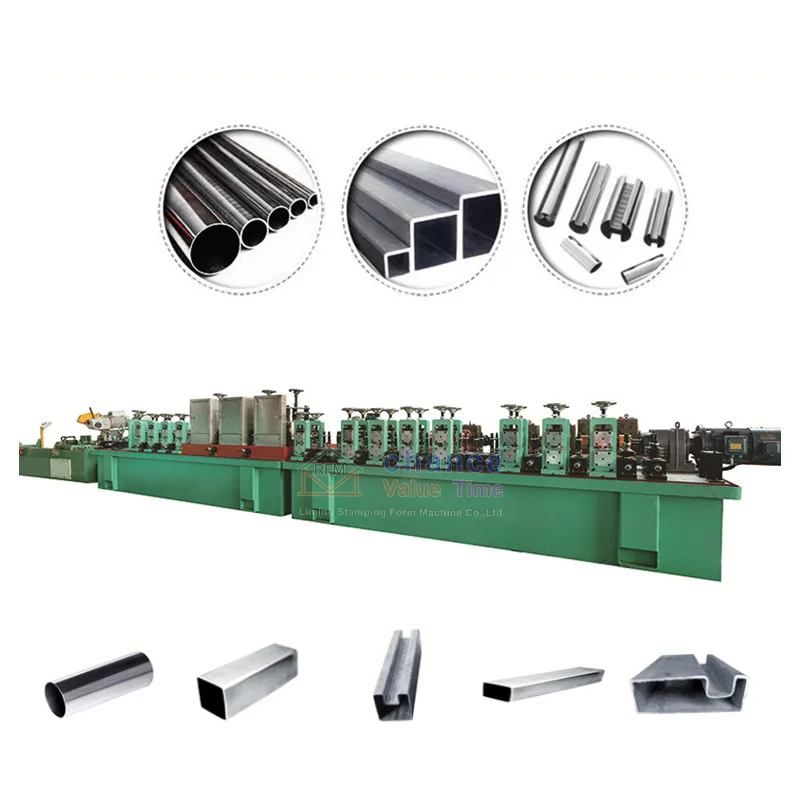
A complete ERW steel pipe making machine consists of several main parts.
The Feeding System Controls Material Input
The feeding system is used to bring the steel strip into the production line.
This system supports the stable strip movement and supports the forming section in taking up the material at the correct speed.
The Forming Unit Creates the Pipe Shape
The forming unit is equipped with a number of roller groups that are used to gradually form the steel strip.
The pipe forming system is designed to ensure that the pipes are round, have square cut ends and are accurate. The roller design must match the pipe size and form.
The High Frequency Welding Device Forms the Seam
The high frequency welding device is used to join the open seam of the pipe.
The key part where the quality of the weld seam can be checked for welded pipes is very important.
The Cooling and Sizing Systems Control Final Geometry
The cooling system of the welder is used to cool and stabilize the welded pipe after the heat input.
The sizing system enables us to shape a pipe to the exact required dimensions. The sizing system is particularly important for square and rectangular steel tubes, in order to exactly meet the buyer’s requirements.
The Cutting and Control Systems Support Continuous Output
The cutting system is used to cut completed pipe stock to length as predefined by user.
Control system controls the production speed, size, operating parameters, and automatic actions. A good control system will aid repeatability.
What Types of Pipes Can the Machine Produce?
A steel welding pipe forming machine can be made to produce a variety of different shapes of pipes, depending on the configuration of the machine and the appropriate tools being used.
The Machine Can Produce Round Steel Pipes
Round steel pipes are used in a variety of applications such as structural frames, support structures, transport applications, mechanical components and general fabrications.
The quality of the round pipe is determined by forming balance, weld seam stability, dimensions accuracy and cutting precision.
The Machine Can Produce Square Steel Tubes
Square steel tubes are widely used in furniture, shelf, fence, frame, door and window making, as well as in steel structure.
The square tube production process needs accurate shaping because the corner shape and side straightness affect the final product appearance and use.
The Machine Can Produce Rectangular Steel Tubes
Rectangular tubes are used for applications that need a particular width, height or strength in particular direction.
Width, height, corner radius, straightness and surface finish must be controlled when producing rectangular tube.
The Machine Can Process Different Metal Materials
Our new slitting machine can be set up to cut: carbon steel, stainless steel, galvanized steel, and many other types of metal strip.
Before selecting a machine the buyer should check the material type, the strip thickness, the strip width, the surface finish and the pipe specifications required.
Where Are Welded Steel Pipes Used?
Industrial welded steel pipes are widely used today because they offer consistent shapes and sizes, as well as competitive production cost.
Construction Projects Use Welded Steel Pipes
Welded steel pipes are used in construction projects for frames, for supports, for railings, for guard structures and in general for steel structures.
A buyer looking to use construction materials is primarily concerned with the quality of those materials, the size of the individual pieces, and the ability of the supplier to deliver a consistent supply over time.
Furniture Manufacturers Use Welded Steel Tubes
Furniture manufacturers use welded tubes in making chairs, tables, shelves, racks, bed frames and even decorative structures.
Smooth surfaces, accurate geometry and cut length are typically critical in furniture applications.
Machinery and Automotive Applications Use Welded Tubes
Welded tubes are used in the production of frames, brackets, equipment and component parts for machinery and automotive applications.
In these applications dimensional repeatability is a key factor. Pipes need to fit in every manufacturing step.
Fencing and Fabrication Projects Use Welded Pipes
Welded pipes are used for fencing and fabrication projects such as barriers, handrails, farm fencing, gates and products for workshops.
Factories serving these markets will need to produce flexible pipe size.
FAQ
What materials can the machine process?
The machine can process carbon steel, stainless steel, galvanized steel, and other suitable strip materials when the machine configuration matches the material and thickness.
What pipe shapes can the machine produce?
It is possible to make round, square or rectangular pipes, by choosing the right forming rollers and size tools, and the right machine design.
Hebei Liming Stamping Form Machine Co.,Ltd specializes in the design, development, and manufacturing of roll forming machines, and its product range includes Welding Pipe Machine solutions for steel pipe production. Buyers can contact Hebei Liming with pipe drawings, material thickness, production speed requirements, voltage requirements, and factory layout details to receive a customized steel welding pipe forming machine recommendation for their production needs.