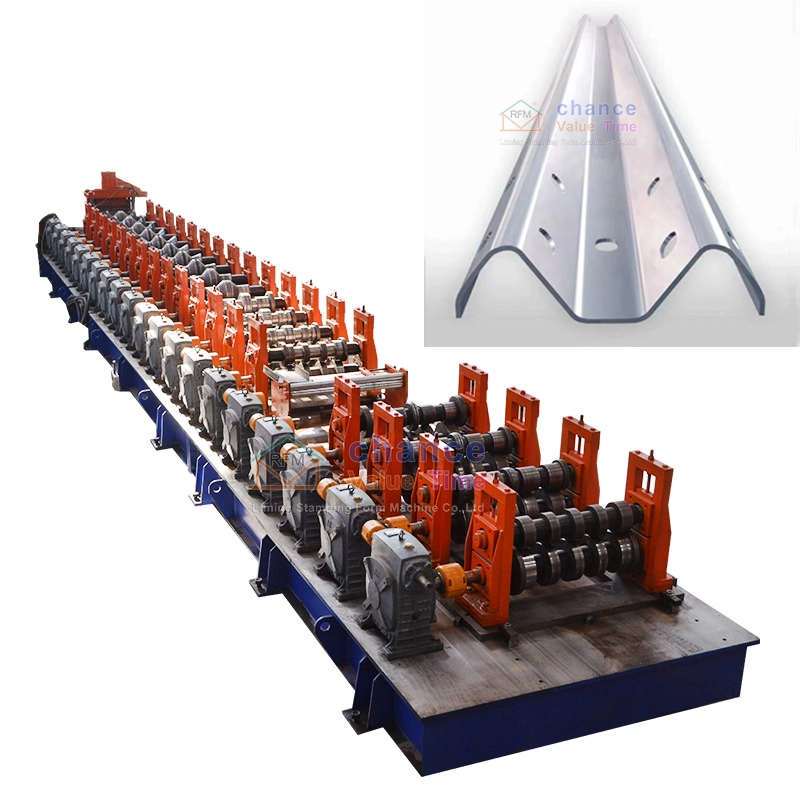
A high-quality guardrail roll forming machine must produce accurate profiles, correctly positioned holes, consistent lengths, and clean steel surfaces during continuous production. A buyer who compares an automatic highway guardrail roll forming machine should evaluate the complete process rather than one headline specification. A properly configured W-beam guardrail production line should match the approved drawing, material properties, hole pattern, target output, and local project requirements.
Roll forming feeds a flat strip through successive pairs of rollers, and each station bends the material incrementally until the final section appears. The number of passes depends on the steel grade, profile complexity, tolerance requirements, and mill design.
What Defines a High-Quality Guardrail Roll Forming Machine
A high-quality machine should reproduce the required wave depth, overall width, edge geometry, panel length, and hole pattern. The buyer should provide an approved drawing because guardrail dimensions and connection details can vary among projects. Highway inspection guidance also emphasizes that approved plans should substantiate relevant dimensions.
Finished-Panel Accuracy
The buyer should measure several consecutive panels instead of accepting one good sample. The inspection should cover panel width, profile height, straightness, twist, hole diameter, hole spacing, cut squareness, and surface condition.
A stable machine should produce similar results throughout a continuous test. The machine should not require repeated manual corrections to maintain the agreed tolerance.
Material Compatibility
The buyer should specify the steel grade, thickness, yield strength, tensile strength, coil width, coil weight, and coating condition.
Higher-strength steel increases forming loads and can require larger shafts, stronger frames, greater overbend, and additional power. Yield-strength variation can also change finished dimensions and pre-punched feature positions.
How an Automatic Highway Guardrail Roll Forming Machine Works
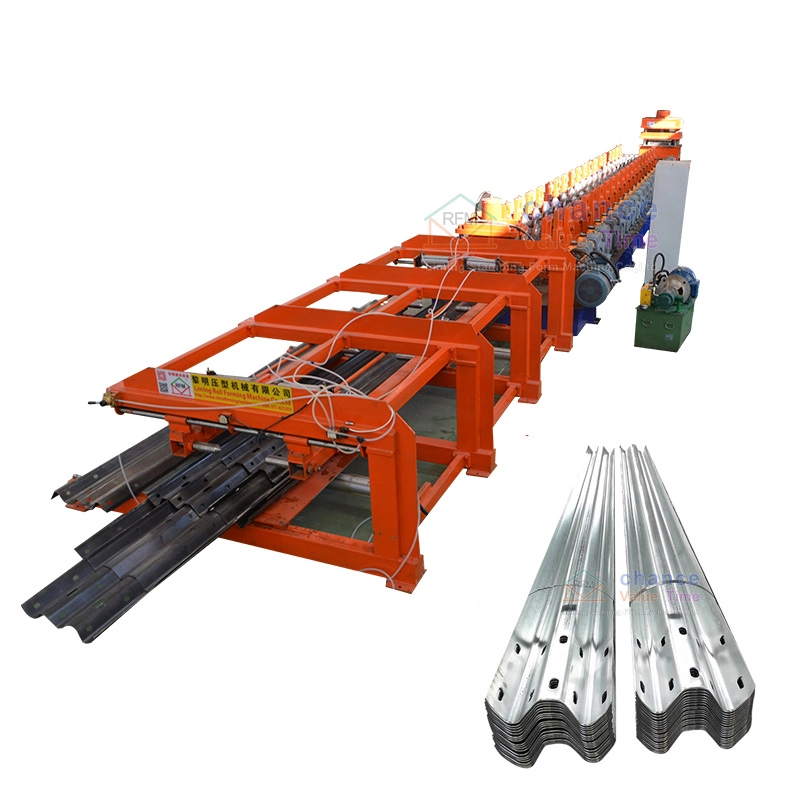
A complete line usually coordinates uncoiling, leveling, punching, roll forming, cutting, control, and finished-panel receiving. Some configurations also include automatic conveying or stacking.
Uncoiling, Leveling, and Guiding
The uncoiler releases the steel coil at a controlled rate. The buyer should confirm the coil capacity, expansion method, braking control, and loading arrangement.
The leveler reduces coil set and incoming strip imperfections before forming. A leveler uses successive work rolls to flex the strip, and its performance depends on roll geometry, rigidity, power, and material properties.
The entry guide centers the strip before punching and forming. Accurate guidance reduces unequal edges and displaced holes.
Punching, Forming, Cutting, and Receiving
The punching unit creates connection holes, reinforcement holes, or slots according to the approved drawing. The forming stations then bend the steel progressively into the specified profile.
The cutting unit separates each panel at the programmed length. The receiving table supports the long finished part and prevents uncontrolled dropping.
W-Beam Guardrail Production Line Coordination
A W-beam guardrail production line must synchronize every module. A fast forming mill cannot improve actual output when the punching cycle, cutting cycle, or discharge system becomes the bottleneck.
The control system should coordinate feeding distance, punching commands, forming speed, cutting position, panel counting, and downstream readiness.
Precision Roll Tooling and Rigid Machine Construction
The roll tooling forms the profile, but the shafts, bearings, stands, frame, and transmission system keep the tooling in its designed position.
Progressive Roller Design
Each forming station should introduce a controlled amount of deformation. An aggressive forming sequence can contribute to springback, edge wave, twisting, bowing, or dimensional variation.
The station count should follow the profile geometry and material properties. Technical guidance states that the number of roll pairs depends on material grade, part complexity, and mill design.
Rollers, Shafts, and Frame Rigidity
The buyer should review roller material, machining accuracy, heat treatment, surface finish, and alignment. Smooth rollers can also help protect galvanized steel from scratches and pressure marks.
The shafts and stands should resist deflection under the expected load. The main frame should remain rigid because stronger material creates greater stress throughout the processing system.
Accurate Punching, Cutting, and PLC Control
Punching and Cutting Accuracy
The buyer should verify hole diameter, center distance, edge distance, slot orientation, burr condition, panel length, and cut-end deformation. The supplier should test material that represents the buyer’s actual production steel.
The dies should match the product geometry. The control system should prevent accumulated feeding errors from shifting holes along a long panel.
PLC and Operator Controls
The operator interface should allow the operator to enter panel length, batch quantity, speed, and punching parameters. The interface should also show production status and clear fault messages.
An encoder or servo system can provide feedback for feeding, punching, and cutting positions when the selected configuration includes those functions.
Production Speed and Effective Output
The buyer should distinguish forming speed from finished-panel output. Actual hourly output depends on panel length, punching time, cutting time, coil changes, material handling, and interruptions.
A useful comparison should include:
- The supplier should state the maximum forming speed.
- The supplier should state the stable working speed.
- The supplier should calculate output for the actual hole pattern.
- The supplier should identify the slowest module.
Published machine configurations show that power, speed, thickness range, dimensions, and transmission method vary by model. The buyer should treat every published figure as configuration-specific.
Essential Safety Features
Guards and Emergency Controls
The machine should use suitable guards around rotating transmission parts, forming hazards, punching points, and cutting areas. Safety requirements state that guarding should protect workers from points of operation, nip points, and rotating parts.
The machine should provide accessible emergency-stop controls and a main power disconnect. Hydraulic press guidance also recommends easy access to emergency stopping and suitable enclosure of pump or transmission arrangements.
The factory layout should define safe coil-loading areas, operator walkways, discharge space, and restricted zones.
Factory Acceptance Test and Quotation Comparison
The factory acceptance test should use the agreed drawing and representative steel. The test should demonstrate automatic feeding, punching, forming, cutting, counting, and receiving through several consecutive panels.
The buyer should record dimensions, surface quality, actual output, interruptions, and manual adjustments. Both parties should approve the results in a written test report.
The buyer should also compare the scope of every quotation. Each proposal should identify the uncoiler, leveler, punching unit, forming mill, cutting unit, receiving table, control cabinet, hydraulic system, and safety guards.
FAQ
Can One Machine Produce W-Beam and Thrie-Beam Guardrails?
One machine can support multiple profiles when the frame, tooling, dies, and control programs are designed for changeover. The buyer should confirm which components require replacement.
How Many Roller Stations Should the Machine Have?
No universal station number applies to every guardrail. The profile complexity, material grade, thickness, tolerance, and pre-punched features determine the suitable number.
What Information Does a Supplier Need?
The supplier needs the profile drawing, material grade, thickness, coil width, coil weight, panel length, hole pattern, required output, power supply, and local project requirements.
How Should a Buyer Verify Machine Quality?
The buyer should inspect several consecutive panels during a continuous automatic test. The buyer should measure the profile, holes, lengths, cut ends, straightness, twist, and surface condition.
Request a Customized Guardrail Production Line
Hebei Liming states that the company has 28 years of experience in roll forming machine design, development, and manufacturing. Hebei Liming offers customized highway guardrail equipment that can integrate uncoiling, leveling, hydraulic punching, progressive roll forming, hydraulic cutting, PLC control, and finished-product receiving. Buyers can submit their profile drawing, material thickness, steel properties, hole pattern, target speed, voltage, and factory requirements to request a tailored machine configuration and quotation. Contact Hebei Liming today to discuss your production requirements and receive a customized guardrail roll forming solution.