A highway guardrail roll forming machine converts steel coil into corrugated road barrier beams through feeding, punching, progressive forming, cutting, and discharge. Buyers comparing a W beam guardrail roll forming machine or a complete highway guardrail production line should evaluate more than machine speed or purchase price. Each buyer should confirm the guardrail drawing, steel properties, hole pattern, required output, automation level, product tolerances, and acceptance criteria before selecting equipment.
What Is a Highway Guardrail Roll Forming Machine?
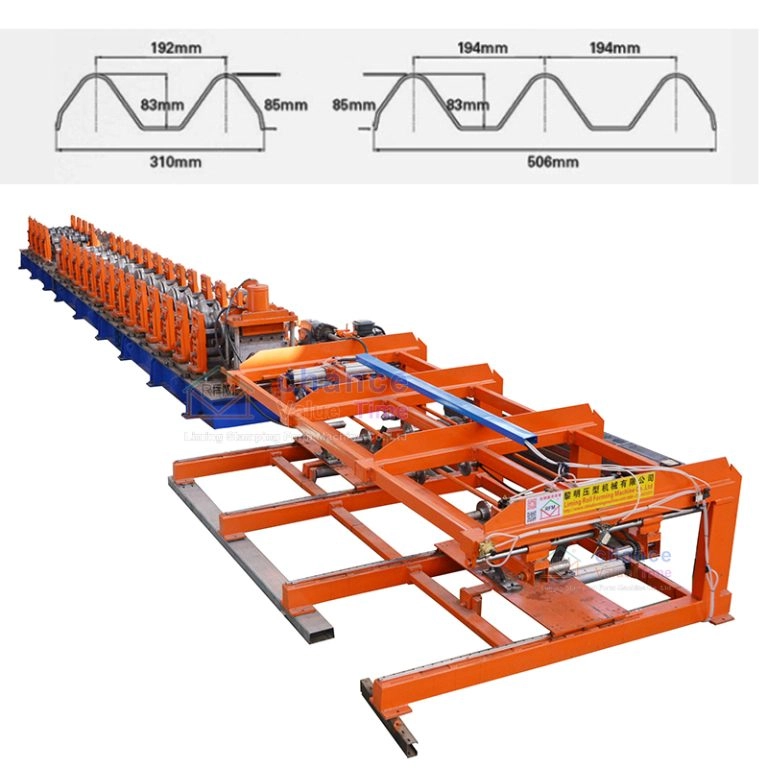
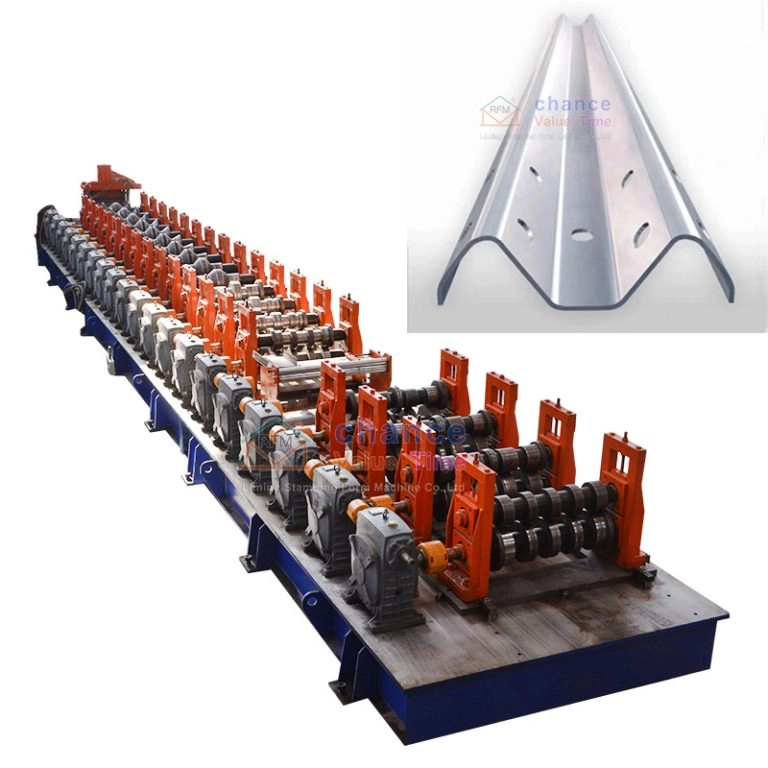
A highway guardrail roll forming machine progressively bends flat steel through multiple roller stations until the required guardrail profile is formed. A complete production line can integrate decoiling, leveling, feeding, punching, roll forming, cutting, conveying, and stacking.
What Products Can the Machine Produce?
A properly designed line can produce W-beam, thrie-beam, or project-specific guardrail profiles. The final capability depends on the approved profile drawing, steel specification, hole arrangement, product length, and tooling design.
W Beam Guardrail Roll Forming Machine vs. Thrie-Beam Machine
W-Beam Production
A W beam guardrail roll forming machine produces a two-wave corrugated profile. The buyer should provide an accurate dimensional drawing because beam dimensions, hole positions, thicknesses, and lengths can differ between projects and markets.
Thrie-Beam and Multi-Profile Production
A thrie-beam line produces a three-wave profile with different geometry and strip width. One machine can sometimes support both W-beam and thrie-beam production when the forming system and tooling are specifically designed for profile changeover.
The buyer should confirm the tooling scope, changeover procedure, expected changeover time, and sample requirements before ordering.
How Does a Highway Guardrail Production Line Work?
Coil Loading, Leveling, and Feeding
The decoiler supports and releases the steel coil into the production line. The leveling and feeding units prepare stable material for accurate punching and forming.
The buyer should confirm coil weight, coil width, inner diameter, outer diameter, material thickness, and loading method.
Punching, Roll Forming, and Cutting
The punching system creates holes and slots according to the approved drawing. The roller stations then progressively bend the strip into the required corrugated profile.
The cutting system separates the formed guardrail into specified lengths. The discharge or stacking section then receives the finished products.
What Raw Material Information Does the Supplier Need?
Thickness, Grade, and Yield Strength
The buyer should provide minimum and maximum steel thickness, material grade, and yield strength. Higher-strength steel can increase forming loads and springback, so thickness alone cannot define the correct machine configuration.
Coating and Coil Width
The buyer should identify whether galvanized or other coated steel will be processed. The buyer should also provide coil width and material tolerances because incoming material variation can influence finished-profile accuracy.
Which Drawings and Standards Should Buyers Confirm?
The Guardrail Drawing Should Control Machine Design
The approved drawing should define cross-sectional dimensions, thickness, beam length, hole size, hole position, steel grade, coating, and dimensional tolerances.
The machine supplier should design the forming, punching, and cutting processes around these requirements.
Product Specifications and Crash Testing Are Different
Different highway authorities can require different guardrail specifications. AASHTO M 180, for example, covers steel components used in highway guardrail systems.
MASH provides crash-testing and evaluation criteria for roadside safety hardware. A roll forming machine itself should therefore not be described as “MASH compliant.” The machine should instead manufacture components that match the approved product drawings and applicable project requirements.
Which Machine Specifications Matter Most?
Forming Tooling and Machine Structure
The buyer should evaluate roller design, tooling material, shaft support, frame rigidity, drive configuration, and tooling scope.
The number of forming stations should result from the profile geometry, steel properties, thickness, and tolerance requirements. A larger number of stations does not automatically mean that one machine is better than another.
Punching, Cutting, and Controls
The punching system should match the actual hole drawing. The cutting system should achieve the required length without unacceptable end deformation.
The control system should coordinate feeding, punching, forming, length measurement, cutting, counting, and fault alarms.
How Should Buyers Evaluate Real Production Capacity?
Nominal forming speed does not equal finished-product output. Punching cycles, cutting cycles, acceleration, coil loading, product discharge, and stacking can reduce actual production capacity.
Buyers Should Compare Pieces per Hour
The buyer should ask the supplier to calculate output using the actual guardrail drawing instead of relying only on metres per minute.
A practical capacity calculation should consider:
- The buyer should define the finished guardrail length.
- The buyer should confirm the number of punching operations per beam.
- The buyer should confirm the punching and cutting cycle times.
- The buyer should calculate realistic pieces per hour.
- The buyer should convert hourly output into shift, monthly, and annual capacity.
A factory that requires 100,000 beams per year should select equipment according to actual productive hours and peak project demand rather than theoretical maximum speed.
Production Bottlenecks Should Be Identified
The punching unit can become the main bottleneck when each beam requires many holes. The cutting system or stacking process can also limit output.
The buyer should therefore request a continuous production test that includes punching, forming, cutting, and discharge.
What Is Included in a Complete Highway Guardrail Production Line?
A complete highway guardrail production line can include a decoiler, leveler, feeder, punching system, roll former, cutting unit, control cabinet, conveyor, and stacker.
The buyer should identify optional equipment separately because different quotation scopes can create large price differences.
What Finished-Product Quality Should Buyers Define?
The buyer should establish measurable requirements for cross-sectional dimensions, hole position, beam length, straightness, twist, surface condition, and cut quality.
The buyer should agree on inspection methods and tolerances before machine manufacturing begins.
What Factory Acceptance Test Should Buyers Require?
A Factory Acceptance Test, or FAT, allows the buyer to verify machine performance before shipment.
The Supplier Should Test Representative Material
The test coil should match the specified material thickness, grade, width, and coating as closely as possible. The supplier should produce full-length guardrails through the complete production process.
The Buyer Should Inspect Finished Guardrails
The buyer should verify:
- The profile dimensions should match the approved drawing.
- The hole sizes and positions should meet the agreed tolerances.
- The finished length should remain within the agreed tolerance.
- The guardrail should meet agreed straightness and twist requirements.
- The surface should not show unacceptable forming or handling damage.
- The cut ends should meet the agreed quality requirement.
The Buyer Should Verify Continuous Production
The FAT should include continuous operation rather than only one sample beam. The buyer should record actual pieces per hour while punching and cutting are active.
If the machine supports several guardrail profiles, the supplier should also demonstrate the agreed tooling or profile changeover procedure.
What Determines Highway Guardrail Roll Forming Machine Price?
A highway guardrail roll forming machine does not have one universal price because each project can require a different engineering scope.
Profile and Material Requirements Affect Cost
A standard W-beam profile can require a different tooling system from a thrie-beam or multi-profile production line. Thicker or higher-strength steel can also require heavier forming components, greater drive capacity, and a more robust machine structure.
Punching and Production Speed Affect Cost
A simple punching pattern normally requires a different configuration from a project that requires multiple holes, slots, or high-speed positioning.
Higher output requirements can also increase the specification of feeding, punching, cutting, controls, and finished-product handling.
Automation and Tooling Affect Cost
Automatic conveying, stacking, multiple tooling sets, and additional profile capability can increase the initial investment.
The buyer should therefore compare quotations using the same drawing, steel specification, output target, automation scope, tooling quantity, and acceptance criteria. The lowest quotation does not necessarily represent the lowest total production cost.
How Should Buyers Evaluate a Machine Supplier?
The buyer should evaluate engineering capability rather than relying only on a machine catalogue or quotation.
The Supplier Should Understand the Product Drawing
A capable supplier should discuss steel properties, profile geometry, punching positions, tolerances, production capacity, tooling strategy, and changeover requirements.
The Supplier Should Provide Manufacturing Evidence
The buyer should request actual machine assembly photographs, production videos, sample guardrails, and dimensional inspection results.
The supplier should also be able to demonstrate continuous production during the FAT.
The Supplier Should Define the Complete Project Scope
The buyer should confirm which tooling, auxiliary equipment, technical documents, commissioning services, operator training, and acceptance tests are included.
A clear technical agreement reduces the risk of comparing quotations that appear similar but contain substantially different equipment scopes.
FAQ
How Much Does a Highway Guardrail Roll Forming Machine Cost?
The price depends on profile design, steel properties, punching requirements, output, automation, tooling, and auxiliary equipment.
Can One Machine Produce W-Beam and Thrie-Beam Guardrails?
One machine can produce both profiles when its forming system and tooling are specifically designed for both sections.
What Thickness Can a Guardrail Machine Process?
The supported thickness depends on the machine design, steel grade, and yield strength.
What Is the Real Production Speed?
The real production speed depends on punching, cutting, finished beam length, stacking, and material handling.
What Information Is Needed for a Custom Machine?
The supplier normally needs the profile drawing, hole drawing, steel specification, thickness, coil width, finished length, required output, automation scope, voltage, and destination requirements.
Get a Custom Highway Guardrail Production Solution from Hebei Liming
Hebei Liming designs and manufactures customized highway guardrail roll forming machines and production lines based on different profiles, materials, and output requirements. If you are planning a new guardrail production project or comparing machine configurations, you can contact Hebei Liming to discuss your guardrail drawing and production requirements.