Choosing the right highway guardrail roll forming machine requires a structured assessment of the finished guardrail, steel specification, output target, factory conditions, automation level, and acceptance criteria. A buyer researching how to choose a highway guardrail roll forming machine also needs to confirm whether the proposed W beam and thrie beam guardrail production line can reproduce the required profiles, holes, lengths, and tolerances under continuous production conditions.
Start with the Finished Guardrail Specification
The finished product determines the machine configuration. A complete inquiry begins with the profile, beam length, hole pattern, material, coating, and applicable standard.
Confirm the Guardrail Profile and Standard
W-beam and thrie-beam guardrails have different corrugated geometries. A multi-profile line may therefore require interchangeable rolls or separate punching and cutting dies.
New W-beam rails used on relevant U.S. highway projects are commonly specified to conform to AASHTO M 180, and project delivery normally includes mill certifications. The production line must therefore be designed around the approved drawing and material specification rather than a generic market profile.
Define Material Properties and Surface Requirements
Steel thickness alone does not define tooling requirements. The specification also needs steel strength, strip width, coil dimensions, coil weight, and coating condition.
Higher-strength steel can produce significant springback during cold roll forming. Research shows that material behavior and forming parameters affect final geometry, which makes real-material trials important when dimensional tolerances are strict.
Understand the Complete Production Process
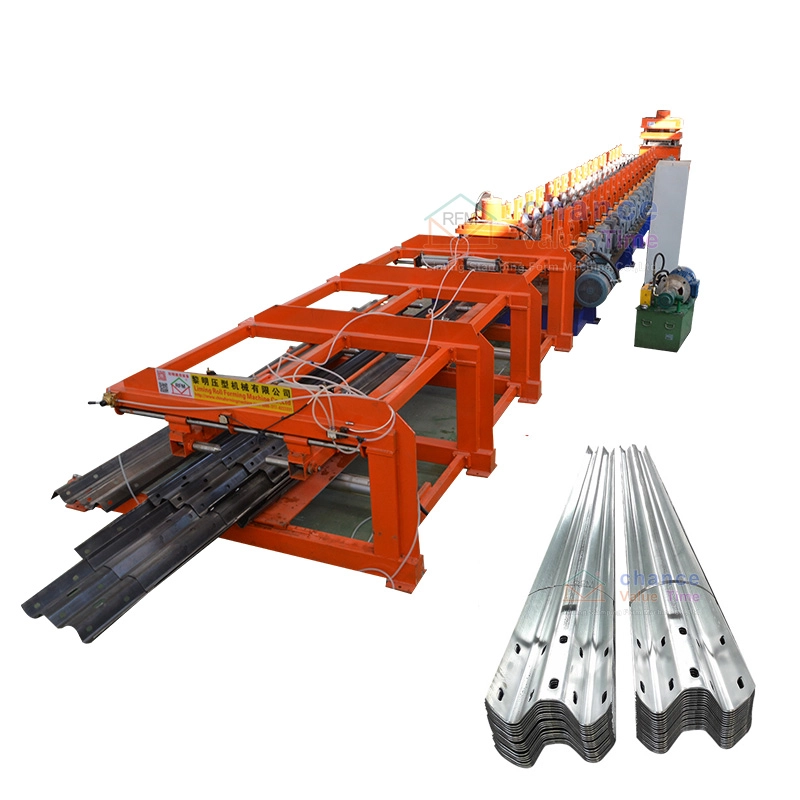
A typical line follows this sequence:
- The uncoiler supports and releases the steel coil.
- The leveler reduces coil curvature and strip distortion.
- The feeder controls strip movement and position.
- The punching unit creates holes and slots.
- The forming stations create the corrugated profile.
- The cutting unit produces the specified length.
- The discharge system transfers and stacks the beams.
Evaluate the Main Line Modules
The uncoiler must match the coil weight and diameters, while the leveler must suit the specified thickness and strength. An encoder-based feeding system can coordinate hole positions and cut lengths, but the quotation needs measurable tolerances.
A stop-punch system pauses the strip, while a synchronized arrangement can support continuous output. The forming stations must distribute deformation gradually. Pre-cutting, stop cutting, and flying cutting also create different effects on continuity and end shape.
Match the Machine to the Required Output
Advertised forming speed does not equal finished-product output. Punching cycles, cutting cycles, coil changes, profile changes, and stacking operations can limit the complete line.
Calculate Real Production Capacity
A capacity calculation needs annual tonnage, shifts, effective working hours, and reserve capacity. Comparable proposals state accepted pieces per hour and tons per shift for a defined profile, thickness, length, and hole pattern.
The punching unit, roll former, cutter, conveyor, and stacker also need compatible cycle rates. A continuous production test provides stronger evidence than an unloaded machine demonstration.
Evaluate Tooling and Product Quality
Tooling quality affects profile geometry, surface condition, and repeatability. The assessment covers roller-pass design, roller material, shafts, bearings, stands, the base frame, and the transmission system.
Define Measurable Acceptance Criteria
The acceptance plan should measure overall width, wave depth, wave spacing, straightness, twist, end flare, hole position, slot size, and finished length. Roll-forming research identifies springback and geometric deviation as material- and process-related concerns, so the machine trial needs to use the contracted steel specification.
Surface inspection should cover scratches, roller marks, coating damage, punching burrs, cutting burrs, and deformation around holes. Pre-coated strip requires controlled guidance and suitable roller surfaces.
Select the Appropriate Automation and Control System
The required automation level depends on output, labor availability, product variety, and traceability requirements. A fully integrated line may coordinate feeding, punching, forming, cutting, counting, conveying, and stacking.
Review Control and Electrical Requirements
A practical control system stores recipes, displays alarms, counts beams, controls speed, and adjusts length and hole positions. The electrical specification also needs voltage, phase, frequency, capacity, and local compliance.
IEC 60204-1 applies to electrical, electronic, and programmable electronic equipment used in industrial machines and coordinated machine groups. The standard provides a relevant reference for defining electrical safety requirements.
Review Machine Safety and Factory Integration
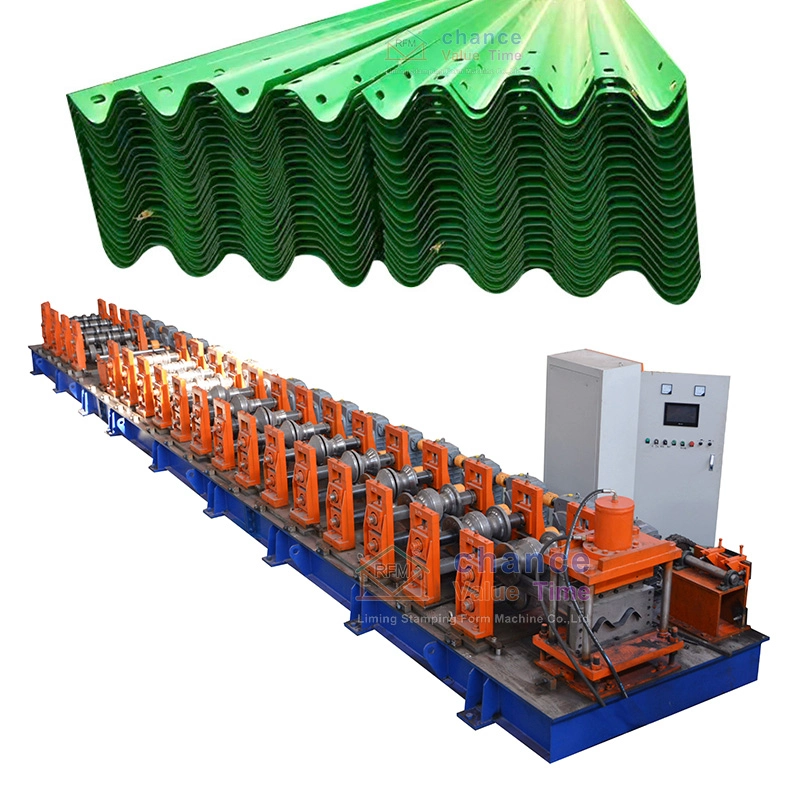
A guardrail line contains rotating shafts, forming rolls, nip points, punching tools, cutting devices, hydraulic systems, and moving long products. The layout therefore needs guarded hazard zones, emergency stops, restart prevention, and safe isolation provisions.
OSHA identifies points of operation, ingoing nip points, rotating parts, and forming rolls as machine hazards that require appropriate guarding. ISO 12100 provides a general methodology for machinery risk assessment and risk reduction.
Confirm Space, Foundations, and Material Flow
The factory layout needs space for coil loading, strip threading, operator access, cabinets, beam discharge, inspection, stacking, and material handling. The floor plan also needs load points, anchor locations, and foundation details.
The material-flow plan should separate coil transport, finished-beam movement, industrial vehicles, and pedestrian access. The available crane or forklift capacity should also correspond to the maximum coil and finished-bundle weights.
Decide Between a Dedicated and Multi-Profile Line
A dedicated W-beam line can suit stable, high-volume production. A dedicated thrie-beam line can suit projects with a consistent three-wave specification. A multi-profile line can provide broader flexibility, but the changeover method requires careful evaluation.
Measure the Real Changeover Requirement
A credible proposal explains which rolls, dies, guides, and settings require adjustment. It also identifies operators, lifting equipment, alignment procedures, trial material, and first-piece approval. A demonstration of each contracted profile provides the clearest confirmation.
A multi-profile claim has limited practical value when the changeover requires excessive alignment work or produces substantial trial scrap. The evaluation should therefore consider the complete changeover time rather than tooling replacement time alone.
Compare Total Project Cost
The project cost includes equipment, tooling, guards, discharge systems, packaging, freight, import charges, foundations, utilities, installation, commissioning, training, and test material.
A production-cost model can also compare labor, energy, scrap, packaging, overhead, and expected utilization. Conservative, base, and high-demand scenarios provide a more realistic payback estimate than maximum advertised speed.
The quotation should clearly distinguish included equipment from optional equipment. The scope should also identify cables, hydraulic connections, safety enclosures, receiving tables, commissioning services, and other items that may otherwise create additional local expenses.
Evaluate the Technical Proposal and Acceptance Test
A complete technical proposal identifies the process layout, component scope, material limits, profile limits, power requirements, safety provisions, output conditions, documentation, and acceptance criteria.
Use Contracted Material During Testing
The factory acceptance test needs the specified material, thickness, coating, beam length, and hole pattern. The record can include running time, accepted output, rejects, dimensional results, alarms, safety functions, and outstanding items.
The contract benefits from measurable guarantees for profile dimensions, hole positions, length tolerance, output, safety functions, and documentation. Photographs and short videos cannot replace an agreed production test.
A complete documentation package normally includes the general arrangement drawing, foundation drawing, electrical schematic, hydraulic schematic, parts list, operating instructions, safety information, and acceptance report.
Avoid Common Purchasing Errors
A purchasing decision based only on price can overlook insufficient tooling, incomplete automation, weak safety provisions, or excluded production modules. A decision based only on maximum speed can also overlook punching, cutting, and stacking bottlenecks.
A quotation that lists only material thickness remains technically incomplete. Steel strength, coating, coil dimensions, product drawings, and dimensional tolerances can materially affect the final machine configuration.
A multi-profile line also requires documented proof for every required profile. Finished samples, continuous testing, dimensional records, and a defined changeover procedure provide stronger evidence than general statements of capability.
FAQ
Can One Line Produce Both W-Beam and Thrie-Beam Guardrails?
One line can produce both profiles when the forming stands, rolls, strip-width range, punching dies, cutting dies, guides, and control recipes are designed for both products. The final decision depends on demonstrated changeover time and verified sample quality.
Which Information Is Needed for an Accurate Quotation?
An accurate quotation normally requires the profile drawing, hole drawing, material grade, thickness, coil dimensions, finished length, output target, voltage, factory layout, applicable standard, and required automation level.
How Can Production Speed Be Verified?
Production speed can be verified through a continuous test that uses the contracted material, profile, hole pattern, cutting method, and stacking process. The result is most meaningful when the record states accepted pieces per hour and tons per shift.
What Should a Factory Acceptance Test Cover?
A factory acceptance test should cover dimensional accuracy, hole position, surface condition, finished length, production output, automatic operation, alarms, emergency stops, interlocks, and product repeatability.
Discuss a Project with Hebei Liming
Hebei Liming provides customized highway guardrail roll forming machine solutions based on specific production requirements. Readers may contact the technical team and submit available profile dimensions, material specifications, drawings, samples, operating conditions, target output, application details, and factory voltage to support an initial technical review and a suitable equipment proposal.