An automated LGS production line and a framing crew do different jobs. The machine turns coil and production data into cut, punched, and formed members. Workers then assemble those members into wall, floor, or roof frames. The useful comparison is where automation replaces repeated preparation, where skilled labor remains, and what volume makes factory equipment practical.
This automated LGS production vs manual framing assembly comparison is for factories, contractors, modular builders, and steel-frame businesses considering a light gauge steel frame machine. Automation does not remove assembly or engineering. It shifts repeated member preparation into a controlled coil-to-component workflow.
Compare the Two Workflows Before Comparing Labor
Manual preparation and assembly
In a mainly manual workflow, workers read drawings or cut lists, measure stock, cut members, mark locations, prepare holes or notches, label pieces, and assemble the frame. Some shops use separate saws, punches, or simple forming equipment, so “manual” rarely means hand tools only. The key point is that several production decisions stay with individual operators at separate stations.
This approach can suit low volume, unusual one-off work, field adjustments, or a business that buys preformed sections rather than manufacturing from coil. It also lets a new operation start without committing to a complete roll forming line. The trade-off is more handling between steps and greater dependence on accurate measurement, labeling, and coordination.
Automated coil-to-component production
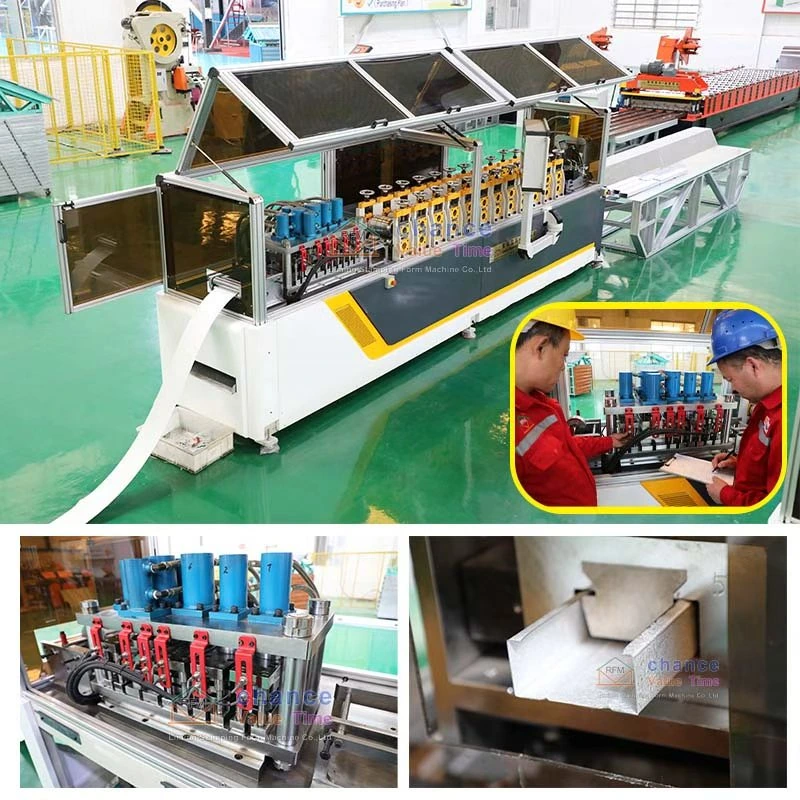
An automated line starts with a defined profile, approved material, and production data. The coil is fed through the machine, and the line performs the configured leveling, punching, roll forming, cutting, and collection steps. Hebei Liming’s C89, C120, and C150 automatic model-change machine describes a sequence that includes leveling, punching, forming, cutting, and material collection.
The machine produces members; it does not approve the building design or complete every assembly task. Frames still need sorting, checking, fastening, lifting, and installation. The gain comes from moving repeatable component preparation into one controlled flow.
Where Automation Changes the Labor Model
Less repeated measuring and marking
Manual preparation uses labor every time a member is measured, marked, cut, or punched. When production data drives those actions in line, the operator’s work shifts toward coil loading, setup verification, production monitoring, quality checks, material handling, and maintenance.
This does not mean every job needs fewer workers. Short batches and frequent profile changes still create setup work. Compare labor per completed project package, including preparation, sorting, rework, and assembly, not just the people beside the machine.
Different skills, not no skills
Automation reduces dependence on repeated manual measurement, but it raises the value of good production data and disciplined setup. Operators need to understand the profile, coil specification, tooling, punching sequence, cut list, and fault response. Production planners must control revisions so the machine does not make an accurate batch from an outdated file.
Assembly skills remain important. Members still need correct identification, placement, fastening, and inspection. The machine makes preparation more repeatable; trained people remain responsible for the frame.
Compare Accuracy Through the Whole Process
Component consistency
A configured line can repeat the same forming, punching, and cutting sequence across a batch, reducing variation from manual measurement. The real test is whether it can hold the required member dimensions and hole positions for the specified material and profile.
Hebei Liming’s roll forming inspection checklist makes this practical. It calls for trial material matching the customer’s actual thickness and material, preferably the same production strip. Samples taken near the start, middle, and end are compared with drawing tolerances for dimensional consistency. Another check measures 5-10 consecutive cut lengths. Surface marks, bow, twist, and springback also receive attention.
For a continuous trial, the checklist specifies 10-30 finished members, with checks for intermittent tracking problems, irregular cutting, dimensional drift, and abnormal heating of the rolls or cut-off tooling. Buyers should agree which checks apply to the proposed LGS configuration and add their hole-position requirements. These are inspection steps, not a universal accuracy guarantee.
Assembly accuracy still has its own controls
Accurate members can still become an inaccurate frame if parts are mixed, placed in the wrong orientation, or fastened incorrectly. Manual and automated factories both need clear piece identification, revision control, assembly fixtures or tables where appropriate, and inspection points.
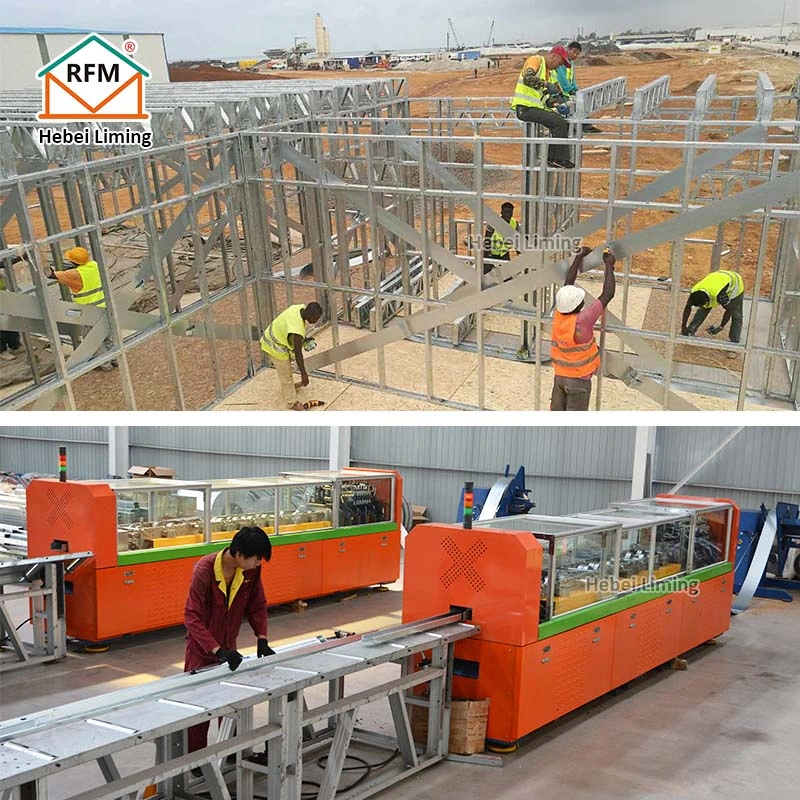
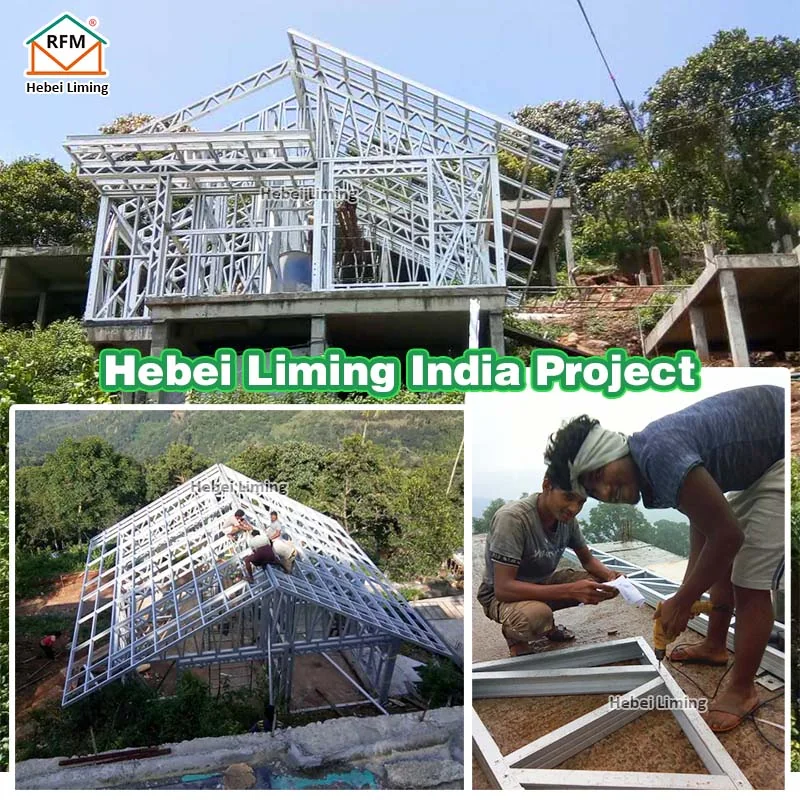
Hebei Liming’s project photos show this next stage: workers position steel members and assemble frames on site. The India project images also show the roof framing. These examples help buyers plan assembly space, fixtures, and labor alongside the machine.
Look at Material Flow and Handling
Manual stock handling
A manual operation may receive preformed studs and tracks in stock lengths. Workers store, cut, and sort them before assembly. Offcuts, mislabeled pieces, and repeated handling grow as the number of member lengths increases.
For occasional projects, this may still be practical. Stock sections are easy to understand, and the business avoids coil purchasing and machine ownership. The decision changes when regular project volume makes repeated cutting, punching, sorting, and stock management a persistent production burden.
Coil-based production
An LGS line uses strip steel matched to the machine and profile. Coil-based production makes members to length but adds purchasing, lifting, storage, traceability, loading, and verification duties.
The buyer should confirm material grade or strength, coating, thickness range, strip width, coil weight, and inner diameter. Those details affect the machine configuration and factory handling plan. Material should never be described only as “galvanized steel” when the design and machine need more specific information.
Decide How Much Profile Flexibility Is Needed
Dedicated and adjustable equipment are different purchases
Some roll forming machines are built around one profile. Others are designed for controlled size adjustment or a defined group of profiles. The product name alone does not prove that a machine can make every stud, track, joist, or truss member a buyer may need.
Hebei Liming publishes both individual LGS models and an automatic model-change option. Buyers should still send the actual profile drawings and ask which dimensions can change automatically, which changes need tooling work, and whether different profile families require separate equipment. This keeps the quotation tied to the planned product range.
Project mix affects the value of flexibility
A factory repeating one framing system may prefer a dedicated setup. A contract manufacturer serving several systems may value controlled changeover. Order mix, batch size, profile ownership, and drawing frequency should decide.
Do not pay for flexibility without defining how it will be used. A short table of expected profiles, monthly batches, change frequency, and target output gives the supplier a clearer basis for discussing machine architecture.
Review the Digital and Production-Data Workflow
Clarify how data reaches the machine
Automated member production depends on reliable data. Ask how profile settings, cut lengths, punching positions, labels, quantities, and sequences are entered. If design or detailing software is included, confirm file compatibility, version control, license scope, training, and unsupported features.
Avoid assuming that a PLC automatically provides a complete design-to-production system. PLC control can manage machine actions, while building design, engineering approval, detailing, and production-file preparation may sit in other software. Each responsibility should be named in the quotation.
Plan revision and traceability controls
The production team needs controls for file approval, batch release, outdated revisions, and project identification. Manual shops need this discipline too, but automation can reproduce a wrong input quickly.
Ask which production records the proposed configuration stores or exports. Define required project, batch, member, and material references before choosing the control system.
Compare Cost Around the Real Bottleneck
Machine price is only one part of the decision. Add coil inventory, data preparation, utilities, lifting, floor space, training, maintenance, assembly tables, packaging, and working capital. Manual production carries different costs: stock-length handling, repeated preparation, separate equipment, and possible rework.
Find where current projects lose time or control. Automation may suit a steady pipeline constrained by repeated member preparation. Irregular projects built around flexible site work can leave a machine underused.
Use the same unit for both options: cost and hours per completed project package, not only meters per minute or hourly wage. Include setup, changeover, quality checks, rework, sorting, and assembly.
Prepare an LGS Machine RFQ
Profiles and full dimensioned drawings
Material grade or strength, coating, thickness, and strip width
Coil weight and inside and outside diameters
Required holes, notches, dimples, marks, and cut details
Monthly project mix, batch sizes, and peak output requirement
Profile-change frequency and required adjustment range
Production-data source, file formats, and software responsibilities
Piece identification and traceability needs
Available floor space, power, air, lifting, and material routes
Required trial material, sample members, training, and acceptance checks
The broader LGS machine guide can help a first-time buyer review basic components. The RFQ should then narrow the discussion to the profile set and production system the factory will actually run.
Hebei Liming’s checklist also covers manuals, electrical drawings, wear-parts lists, and demonstrations of material adjustment, parameter changes, basic troubleshooting, and lubrication. Both sides confirm and retain trial samples and sign the acceptance record. Include the agreed handover scope in the order.
FAQ
Does an automated LGS machine assemble complete frames?
Normally, the machine forms, punches, cuts, and outputs configured members. Frame sorting, positioning, fastening, inspection, and installation remain separate production or construction steps unless other equipment is included.
Is automated LGS production always cheaper than manual preparation?
No. The result depends on project volume, batch size, labor, material handling, software, setup, utilization, rework, and the work included in each comparison.
Can one LGS machine make every framing profile?
No general assumption is safe. Each machine has a defined profile and adjustment scope. Send drawings and ask the supplier to confirm every required member.
What should a buyer send for an LGS machine quotation?
Send profile drawings, material data, punching and cutting details, project volume, changeover needs, production-data requirements, factory utilities, and sample acceptance criteria.
Discuss the Production Plan with Hebei Liming
Hebei Liming has 30 years of experience in roll forming equipment and supplies LGS solutions for different profile and production requirements. Buyers can review the company’s manufacturing and international project background and contact Hebei Liming with their drawings, material specification, project mix, production-data workflow, and factory layout. Those inputs allow a model-specific discussion without treating automation as a substitute for engineering or assembly planning.