
This sandwich panel machine troubleshooting guide helps production teams identify defects before they create waste, rejected products, or delivery delays. The guide covers common sandwich panel production line problems, including delamination, uneven thickness, wrinkles, misaligned layers, and cutting errors.
The guide also explains how to fix sandwich panel delamination by checking adhesive coverage, facing preparation, laminating conditions, and material synchronization. Buyers can compare their process with the equipment scope described on Hebei Liming’s Sandwich Panel Machine product page.
How to Use This Sandwich Panel Machine Troubleshooting Guide
Start with the Visible Panel Defect
The operator should determine whether the defect affects the full panel or one area. An edge defect often suggests a guiding problem, while a full-width defect may indicate unstable bonding or pressure.
Follow the Production Sequence
The operator should check coil feeding, roll forming, core feeding, adhesive application, laminating, cutting, and discharge in sequence. This approach reveals the earliest stage where the defect appears.
Common Sandwich Panel Production Problems at a Glance
| Panel symptom | Likely cause | First inspection point |
|---|---|---|
| Delamination | Weak bonding or contaminated surfaces | Adhesive coverage and facings |
| Uneven thickness | Inconsistent core feed or pressure | Core dimensions and laminating section |
| Surface wrinkles | Unbalanced tension or roller pressure | Coil feeding and forming section |
| Misaligned layers | Incorrect material tracking | Entry and side guides |
| Incorrect length | Measurement or timing error | Encoder and cutter control |
| Damaged edges | Incorrect guiding or cutting | Side guides and cutting section |
How to Diagnose Sandwich Panel Delamination
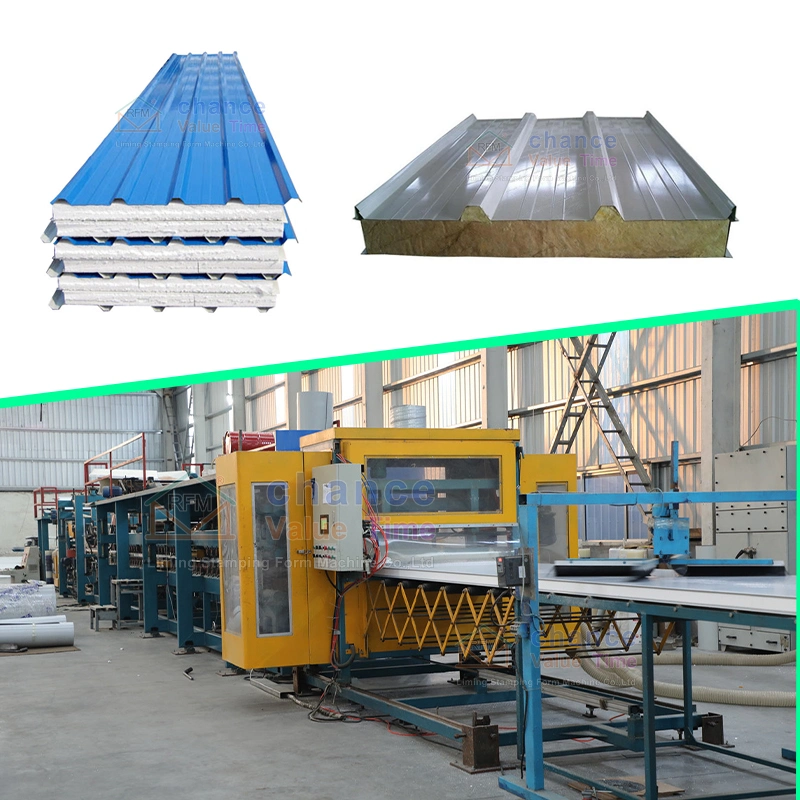
Delamination occurs when a metal facing separates from the insulation core. The defect may appear as a loose edge, hollow area, or blister. The team should identify the affected area before changing the bonding process.
Check Adhesive Coverage and Consistency
The adhesive should cover the required bonding area evenly. Missing strips, unstable output, or an unsuitable application rate can create weak zones between the facing and core.
The operator should compare adhesive distribution at the center and both sides against the approved requirement.
Inspect the Metal Facing Surfaces
Oil, dust, moisture, and processing residue can reduce bonding strength. The operator should inspect both facings before lamination.
Verify Bonding Conditions
The bonding process depends on pressure, temperature, line speed, and curing time. An incorrect balance can produce weak adhesion even when adhesive coverage appears satisfactory.
The operator should compare actual values with the approved setup record and change one parameter at a time.
Check the Core Material
A wet, damaged, uneven, or incorrectly positioned core can cause local separation. The operator should verify the core thickness, density, surface condition, and position.
Readers can review Hebei Liming’s guide to the components of a sandwich panel production line for line structure.
How to Solve Uneven Thickness and Poor Panel Flatness
Uneven thickness reduces joint accuracy, while poor flatness makes panels difficult to stack and install.
Measure Core Distribution
The quality team should measure each test panel at the center and both edges. Several measurements can show the variation pattern.
A thick area may indicate excess core material or insufficient compression. A thin area may indicate a feed gap, excessive pressure, or an unsuitable core dimension.
Check Pressure and Synchronization
Uneven laminating pressure can create thickness variation even when the core is consistent. The operator should compare results across the full width.
The metal facings, core, and laminating section should move at compatible speeds. Poor synchronization can stretch one material while compressing another.
How to Fix Surface Wrinkles, Scratches, and Dents
Surface defects often originate from unstable tension, incorrect pressure, poor tracking, or foreign particles.
Diagnose Metal-Facing Wrinkles
Wrinkles may form when the facing enters the roll forming section at an angle or under uneven tension. The operator should confirm that the sheet remains centered without sideways movement.
Locate Scratches and Surface Marks
A repeated scratch usually follows a fixed contact point. The operator should compare the mark with guides, rollers, and conveyors.
Investigate Dents and Local Damage
Local dents can result from concentrated pressure, trapped debris, or unstable panel handling. The operator should identify the stage where the dent first appears and adjust only that section.
How to Correct Panel Misalignment and Crooked Edges
Misaligned layers produce irregular widths, exposed core material, and poor joints. These sandwich panel production line problems often begin before lamination.
Check Coil Tracking and Entry Guides
Both metal facings should follow the same centerline. The operator should watch whether either sheet gradually moves toward one side during production.
Incorrect entry guides can force a sheet into the forming section at an angle. The guides should control the material without excessive side pressure.
Check Core Centering and Side Guides
The core should remain centered between the upper and lower facings. A shifted core can create an overhanging edge on one side and an uncovered area on the other.
The side guides should maintain a consistent path without deforming edges. The operator should produce a short test panel after correction.
How to Troubleshoot Incorrect Panel Length and Cutting Defects
Length and cutting defects create material loss, damage panel joints, and disrupt installation schedules.
Check the Length Measurement Signal
The operator should compare the displayed length with physical measurements from several panels. A consistent difference may indicate a calibration error. Irregular differences may indicate unstable feeding or signal loss.
The encoder should measure actual material movement. Slippage can make the recorded distance inaccurate.
Inspect Cutting Synchronization and Edges
The cutting action should match panel movement. Incorrect timing can produce slanted cuts, crushed ends, or variable lengths.
A clean cut should not crush the facing or tear the core. One-sided damage may indicate misalignment, while full-width damage may indicate an unsuitable cutting action.
How to Resolve Coil Feeding and Material Flow Problems
Stable material flow supports every downstream process. Unstable feeding can cause wrinkles, misalignment, length errors, and inconsistent panel geometry.
Recognize Coil Tension Problems
Excessive tension can stretch thin facings and affect profiling. Insufficient tension can allow the sheet to wander or form loops. The operator should evaluate tension together with sheet thickness and line speed.
Identify Material Slippage
Material slippage can interrupt synchronization. The operator should determine whether it appears during acceleration, steady production, or cutting because the timing can reveal the responsible section.
Confirm Material Compatibility
The production team should confirm facing thickness, coating, core type, dimensions, and bonding requirements before production. An unsuitable combination can resemble a machine fault.
A Controlled Root-Cause Process for Production Problems
A structured process reduces unnecessary adjustments.
- The operator should identify, measure, and photograph the defect.
- The operator should determine whether the defect follows a repeating pattern.
- The production team should verify raw materials before changing settings.
- The operator should inspect each section in production order.
- The operator should change only one controlled variable at a time.
- The operator should produce a limited test panel after each change.
- The quality team should record the result before full output resumes.
How to Reduce Repeat Defects Through Production Control
A factory can reduce repeat defects by controlling specifications and setup records.
Use Approved Settings for Each Panel
Each panel specification should have a documented setup record. The record should identify the facing material, core type, panel dimensions, line speed, bonding conditions, and cutting length.
Create a Production Defect Record
The record should include the defect type, material batch, operating values, affected area, and corrective action.
Approve Samples Before Full Output
The quality team should approve initial samples before continuous output begins. The team should check bonding, thickness, width, length, flatness, surface condition, and edge quality.
When Should a Factory Contact Its Machine Supplier?
A factory should contact its supplier when controlled adjustments do not eliminate a recurring defect or when a new material, profile, or specification requires different settings.
The team should provide photos, material details, operating values, and a clear defect description.
FAQ
What Causes Sandwich Panel Delamination?
Uneven adhesive coverage, contaminated facings, unsuitable bonding conditions, unstable core feeding, and incompatible materials can cause delamination.
Why Are Sandwich Panels Not Flat?
Uneven core thickness, unbalanced pressure, unstable tension, and poor synchronization can reduce panel flatness.
Why Does the Machine Produce Incorrect Panel Lengths?
Unstable feeding, material slippage, inaccurate signals, or incorrect cutting synchronization can produce length errors.
How Can Operators Find the Cause of Repeated Wrinkles?
Operators should inspect coil tracking, sheet tension, entry alignment, roller contact, and guide positions.
Discuss Your Sandwich Panel Production Requirements
Hebei Liming has 30 years of experience in designing, developing, and manufacturing roll forming machinery. The company provides customized equipment solutions, including Sandwich Panel Machines, for different material, panel, and output requirements. Production teams can review the company’s manufacturing background and contact Hebei Liming to discuss panel specifications and production-line configuration.